
MAGAZINE ARTICLES FROM THE 1850s
PART TWO
1830s | 1840s | 1850s part 1 | 1860s | 1870s | 1880s | 1890 onward
"Labour & the Poor" London Morning Chronicle (July 29,1850) | International Mag (1850)
Living Age (1850) | Chambers' Repository (1852) | Edinburgh Christian Mag. (1854)
London Quarterly Review (1854) | Arthur's Magazine (1854) | National Magazine (1854)
Church Rev. (1855) | Tribune Almanac (1859) | Atlantic Monthly (1859) | Harpers (1859)
|
Henry Mayhew (1812-1887) "Labour and the Poor (of Liverpool) Letter No. 9" The Morning Chronicle London: July 29, 1850 (an expanded version was reprinted in: The Mormons, or Latter-Day Saints (London, Nat. Ill. Library, 1851) |
|
|
-------------------------------------------------------------------------------------------------------------------- Vol. ? London, U. K., Monday, July 29, 1850. No. ? -------------------------------------------------------------------------------------------------------------------- [ 6 ]
LABOUR AND THE POOR
During the course of my inquiry into the extent of emigration from the port of Liverpool, I learned that the followers of Joseph Smith, the Mormon Prophet, who are known by the names of Mormons, Mormonites, and Latter-Day Saints, had many years ago established an emigrational agency in the town, having ramifications in all parts of England, Wales, and Scotland. I learned that the number of Mormon emigrants sailing from the port of Liverpool to New Orleans, on their way to Deseret and Upper California, during the year 1849, was no less than 2,600 -- chiefly farmers and mechanics of a superior class, from Wales, Lancashire and Yorkshire, and the southern counties of Scotland; and that since 1840 the total emigration of the sect from Great Britain has been between 13,000 and 14,000. The progress and present position of this remarkable sect both in the United States and in Great Britain, will put the reader in possession of the facts necessary to the due comprehension of the subject. They unfold one of the most curious episodes in the modern history of the world, and certainly the most singular story in the recent annals of fanaticism The founder of the sect -- Joseph Smith, jun., as he was called till within a year or two of his death -- was born in 1805. The first congregation of Latter- day Saints was organized in 1831, and now, in less than twenty years, the sect numbers nearly 30,000 people in Great Britain, and about four times, or according to some statements six times, that number in America. Joseph Smith was a digger for gold before he took up the trade of preaching and prophesying; and to his people after his people after his death belongs the merit, or the credit, of discovering the gold of California. The Mormons are now the principal inhabitants of a State to which they have given the name of Deseret, a word that occurs in their new Bible, or Book of Mormon, and which is said to signify a honey-bee. They expect, within a short time, by means of immigration from Great Britain, and by the gathering together of their people from all parts of the Union, to muster a sufficient number in Deseret to claim formal admission into the American Union. The number of inhabitants requisite for this purpose is 60,000, and there can be little, if any doubt, that, in a few years, the object of the Mormons will be accomplished. Such is the present position of the Latter-day Saints. The growth of Mohomedanism, rapid as it was, is not to be compared to the rise and growth of Mormonism. I now proceed to detail more particularly the history of Joseph Smith and the sect he founded -- appending an abstract of their religious belief. To avoid the appearance of unfriendliness towards men who -- whatever the character, or views of their leader may have been, or whatever may be thought of their own fanaticism -- are carrying on a remarkable work, but little understood, or even heard of, in this country beyond the limits of their own body, I shall, whenever it is possible to do so, present their history in the words of their own writers, appending such statements as may be necessary for the exposition of the truth. The following particulars are extracted from the Remarkable Visions of Mr. Orson Pratt, their emigrational agent at Liverpool, a gentleman who styles himself, in the title-page, One of the twelve Apostles of the Church of Jesus Christ of Latter-day Saints; but who is styled in Liverpool, Head Apostle of the Latter-day Saints in England, and chief Agent for the Church of Jesus Christ for all Europe: -- "Mr. Joseph Smith, jun. who made the following important discovery, was born the town of Sharon, Windsor County, Vermont, on the 23d December, 1805. When ten years old his parents, with their family, moved to Palmyra. New York, in the vicinity of which he resided for about eleven years, the latter part in the town of Manchester. He was a farmer by occupation. His advantages for acquiring scientific knowledge were exceedingly small, being limited to a slight acquaintance with two or three of the common branches of learning. He could read without much difficulty, and write a very imperfect hand, and had a very limited understanding of the elementary rules of arithmetic. These were his highest and only attainments, while the rest of those branches so universally taught in the common schools throughout the United States were entirely unknown to him. -- When somewhere about fourteen or fifteen years old, he began seriously to reflect upon the necessity of being prepared for a future state of existence; but how, or in what way to prepare himself, was a question as yet undetermined in his own mind. He perceived that it was a question of infinite importance, and that the salvation of his soul depended upon a correct understanding of the same. * * * He retired to a secret place in a grove, but a short distance from his father's house, and knelt down and began to call upon the Lord. At first he was severely tempted by the powers of darkness, which endeavoured to overcome him, but he continued to seek for deliverance until darkness gave way from his mind, and he was enabled to pray in fervency of the spirit, and in faith; and while thus pouring out his soul, anxiously desiring an answer from God, he at length saw a very bright and glorious light in the heavens above, which at first seemed to be at a considerable distance. He continued praying, while the light appeared to be gradually descending towards him; and as it drew nearer it increased in brightness and magnitude, so that by the time it reached the tops of the trees the whole wilderness around was illuminated in a most glorious and brilliant manner. He expected to see the leaves and boughs of the trees consumed as soon as the light came in contact with them; but perceiving that it did not produce that effect he was encouraged with the hopes of being able to endure its presence. It continued descending slowly, until it rested upon the earth, and he was enveloped in the midst of it. When it first came to him, it produced a peculiar sensation throughout his whole system; and immediately, his mind was caught away from the natural objects with which he was surrounded, and he was enwrapped in a heavenly vision, and saw two glorious personages, who exactly resembled each other in their features or likeness. He was informed that his sins were forgiven. He was also informed upon the subjects, which had for some time previously agitated his mind -- namely, that all the religious denominations were believing in incorrect doctrines, and consequently that none of them was acknowledged of God as his church and kingdom. And he was expressly commanded to go not after them; and he received a promise that the true doctrine, the fulness of the gospel, should at some future time be made known to him; after which, the vision withdrew, leaving his mind in a state of calmness and peace indescribable. Some time after having received this glorious manifestation, being young, he was again entangled in the vanities of the world, of which he afterwards sincerely and truly repented. "And it pleased God, on the evening of the 21st Sept., A.D. 1823, to again hear his prayer. * * * It [seemed] as though the house was filled with consuming fire. This sudden appearance of a light so bright, as must naturally be expected, occasioned a shock of sensation visible to the extremities of the body. It was, however, followed with a calmness and serenity of mind, and an overwhelming rapture of joy, that surpassed understanding, and, in a moment, a personage stood before him. -- Notwithstanding the brightness of the light which previously illuminated the room, yet there seemed to be an additional glory surrounding or accompanying this personage, which shone with an increased degree of brilliancy, of which he was in the midst; and though his countenance was as lightning, yet it was of a pleasing, innocent, and glorious appearance; so much so, that every fear was banished from the heart, and nothing but calmness pervaded the soul. -- The stature of this personage was a little above the common size of men in his age; his garment was perfectly white, and had the appearance of being without seam. This glorious being declared himself to be an angel of God, sent forth by commandment to communicate to him that his sins were forgiven, and that his prayers were heard; and also, to bring the joyful tidings that the covenant which God made with ancient Israel concerning their posterity, was at hand to be fulfilled; that the great preparatory work for the second coming of the Messiah was speedily to commence; that the time was at hand for the gospel in its fulness, to be preached in power to all nations, that a people might be prepared with faith and righteousness, for the Millennial reign of universal peace and joy. "He was informed, that he was called and chosen to be an instrument in the hands of God, to bring about some of his marvellous purposes in this glorious dispensation. It was also made manifest to him that the American Indians were a remnant of Israel; that when they first emigrated to America they were an enlightened people, possessing a knowledge of the true God, enjoying his favour, and peculiar blessings from his hand; that the prophets, and inspired writers among them, were required to keep a sacred history of the most important events transpiring among them; which history was handed down for many generations, till at length they fell into great wickedness; the [most] part of them were destroyed, and the records * * * were safely deposited, to preserve them from the hands of the wicked, who sought to destroy them. He was informed that these records contained many sacred revelations pertaining to the Gospel of the kingdom, as well as prophecies relating to the great events of the last days; and that to fulfil his promises to the ancients, who wrote the records, and to accomplish his purposes in the restitution of their children, they were to come forth to the knowledge of the people. If faithful, he was to be the instrument who should be thus highly favored in bringing these sacred writings before the world. * * * After giving him many instructions concerning things past and to come, he disappeared, and the light and glory of God withdrew, leaving his mind in perfect peace, while a calmness and serenity indescribable pervaded his soul. But before morning the vision was twice renewed, instructing him further and still further concerning the great work of God about to be performed on the earth. In the morning he went out to his labour as usual, but soon the vision was renewed -- the angel again appeared, and having been informed, by the previous visions of the night, concerning the place where those records were deposited, he was instructed to go immediately and view them. "Accordingly he repaired to the place, a brief description of which shall be given in the words of a gentleman named Oliver Cowdery, who has visited the spot: -- "As you pass on the mail-road from Palmyra, Wayne county, to Canandaigua, Ontario county, New York, before arriving at the little village of Manchester, say from three to four, or about four miles from Palmyra, you pass a large hill on the east side of the road. * * * It was at the second-mentioned place where the record was found to be deposited, on the west side of the hill, not far from the top, down its side; and when myself visited the spot in the year 1830, there were several trees standing -- enough to cause a shade in summer, but not so much as to prevent the surface being covered with grass -- which was also the case when the record was first found."During the period of the four following years, he frequently received instructions from the mouth of the heavenly messenger. And on the morning of the 22d of September, A.D. 1827, the angel of the Lord delivered the records into his hands. "These records were engraved on plates, which had the appearance of gold. Each plate was not far from seven by eight inches in width and length, being not quite as thick as common tin. They were filled on both sides with engravings, in Egyptian characters, and bound together in a volume as the leaves of a book, and fastened at one edge with three rings running through the whole. This volume was something near six inches in thickness, a part of which was sealed. The characters or letters upon the unsealed part were small, and beautifully engraved. The whole book exhibited many marks of antiquity in its construction, as well as much skill in the art of engraving. With the records was found "a curious instrument, called by the ancients the Urim and Thummim, which consisted of two transparent stones, clear as crystal, set in the two rims of a bow. This was in use in ancient times by persons called seers. It was an instrument, by the use which they received revelation of things distant, or of things past or future. * * * Having provided himself with a home, he commenced translating the record, by the gift and power of God, through the means of the Urim and Thummim; and being a poor writer, he was under the necessity of employing a scribe to write the translation as it came from his mouth. "In the meantime, a few of the original characters were accurately described and translated by Mr. Smith, which, with the translation, were taken by a gentleman, by the name of Martin Harris, to the city of New York, where they were presented to a learned gentleman of the name of Anthon, who professed to be extensively acquainted with many languages, both ancient and modern. He examined them, but was unable to decipher them correctly; but he presumed that if the original records could be brought, he could assist in translating them. "But to return -- Mr. Smith continued the work of translation, as his pecuniary circumstances would permit, until he finished the unsealed part of the records. The part translated is entitled the 'Book of Mormon,' which contains nearly as much reading as the Old Testament. * * * "After the book was translated, the Lord raised up witnesses to the nations of its truth, who, at the close of the volume, send forth their testimony, which reads as follows: --
[Such is] the story of Mr. Orson Pratt, derived from himself, and [also from] the corroboration of [the] witnesses. It will be seen that the latter were principally of the two families of Whitmer and Smith. The Smiths were the father and brothers of Joseph. The next incident is the appointment of Joseph to the priesthood. It is related by Joseph himself in the followhing terms in the Millennial Star, vol. iii, page 148: -- While we (Joseph Smith and Oliver Cowdery) were thus employed, praying and calling upon the Lord, a messenger from heaven descended in a cloud of light, and having laid his hands upon us, he ordained us, saying unto us, "Upon you, my fellow-servants, in the name of the Messiah, I confer the priesthood of Aaron, which holds the keys of the ministering of angels, and of the gospel of repentance and of baptism by immersion for the remission of sins; and this shall never be taken away from the earth until the sons of Levi do offer again an offering unto the Lord in righteousness." He said this Aaronic priesthood had not the power of laying on of hands for the gift of the Holy Ghost, but this should be conferred on us hereafter; and he commanded us to go and be baptized, and gave us directions that I should baptize Oliver Cowdery, and afterwards that he should baptize me. Accordingly we went and were baptized. I baptized him first, and afterwards he baptized me. After which I laid my hands upon his head, and ordained him to the Aaronic priesthood; afterwards he laid his hands on me, and ordained me to the same priesthood, for so we were commanded. The messenger who visited us on this occasion, and conferred this priesthood upon us, said that his name was John, the same that is called John the Baptist in the New Testament, and that he acted under the direction of Peter, James, and John, who held the keys of the priesthood of Melchisedeck, which priesthood, he said, should in due time be conferred on us -- and that I [should be called the first first elder, and he the second. It was on the 15th day of May, 1829, that we were baptized and ordained under the hand of the messenger.] .... [illegible lines follow]... [Insert for 1851 reprint: The scheme was now ripe for a fuller development; but as we have hitherto had the story as in the words of Joseph himself, and of his ardent disciples, Mr. Orson Pratt and the "witnesses," it is necessary to go back a little, and narrate a few circumstances relative to one of the most important of these witnesses, and to the manner in which he was originally induced to become a believer in the "prophet" and his book. It will also be necessary to inquire whether the statements of Mr. Pratt, with reference to Professor Anthon, were admitted by that gentleman.] Joseph Smith having made known his doctrine to various persons, the wonderful plates, began to be talked about. Among the persons who were originally most disposed to join the new sect was Mr. Martin Harris, whose name appears along with those of other witnesses in the above testimony. Mr. Orson Pratt does not, however, state the whole of the facts connected with the interview of Martin Harris with Mr. Anthon, of New York, the learned professor to whom he alludes. A report having, been spread abroad by the Mormons that the Professor had seen the plates, and pronounced the inscriptions to be in the Egyptian character, that gentleman was requested by a, letter, directed to him by Mr. E. D. Howe, of Patnesville, Ohio, to declare whether such was the fact. Professor Anthon returned the following answer... New York, Feb. 17, 1834. Dear Sir. -- I received your letter of the 9th, and lose no time in making a reply. The whole story about my pronouncing the Mormonite inscription to be 'Reformed Egyptian Hieroglyphics,' is perfectly false. Some years ago a plain, apparently simple-hearted farmer, called on me with a note from Dr. Mitchell, of our city, now dead, requesting me to decipher, if possible, a paper which the farmer would hand me. Upon examining the paper in question, I soon came to the conclusion that it was all a trick, perhaps a hoax. 'When I asked the person who brought it how he obtained the writing, he gave me the following account: -- A 'gold book,' consisting of a number of plates fastened together by wires of the same material, had been dug up in the northern part of the State of New York, and along with it an enormous pair of 'spectacles!' These spectacles were so large, that if any person attempted to look through them, his two eyes would look through one glass only; the spectacles being altogether too large for the human face. 'Whoever,' he said, 'examined the plates through the glasses, was enabled not only to read them, but fully to understand their meaning. All this knowledge, however, was confined to a young man, who had the trunk containing the book and spectacles in his sole possession. This young man was placed behind a curtain, in a garret, in a farm-house, and being thus concealed from view, he put on the spectacles occasionally, or rather, looked through one of the glasses, deciphered the characters in the book, and having committed some of them to paper, handed copies from behind the curtain to those who stood outside. Not a word was said about their having been deciphered by the 'gift of God.' Everything in this way was effected by the large pair of spectacles. The farmer added, that he had been requested to contribute a sum of money towards the publication of the 'golden book,' the contents of which would, as he was told, produce an entire change in the world, and save it from ruin. So urgent had been these solicitations, that he intended selling his farm, and giving the amount to those who wished to publish the plates. As a last precautionary step, he had resolved to come to New York, and obtain the opinion of the learned about the meaning of the paper which he had brought with him, and which had been given him as part of the contents of the book, although no translation had at that time been made by the young man with the spectacles. On hearing this odd story, I changed my opinion about the paper, and instead of viewing it any longer as a hoax, I began to regard it as part of a scheme to cheat the farmer of his money, and I communicated my suspicions to him, warning him to beware of rogues. He requested an opinion from me in writing, which of course I declined to give, and he then took his leave, taking his paper with him. This letter speaks for itself, and needs no comment. The following summary of the contents of the Book of Mormon, thus strangely issued into the world, is from a publication called the Voice of Warning, by Parley P. Pratt, another apostle "The Book of Mormon contains the history of the ancient inhabitants of America, who were a branch of the house of Israel, of the tribe of Joseph; of whom the Indians are still a remnant; but the principal nation of them having fallen in battle, in the fourth or fifth century, one of their prophets, whose name was Mormon, saw fit to make an abridgment of their history, their prophiecies, and their doctrine, which he engraved on plates, and afterwards, being slain, the record fell into the hands of his son Moroni, who, being hunted by his enemies, was directed to deposit the record safely in the earth, with a promise from God that it should be preserved, and should be brought to light in the latter days by means of a Gentile nation, who should possess the land. The deposit was made about the year 420, on a hill then called Cumora, now in Ontario county, where it was preserved in safety until it was brought to light by no less than the ministry of angels, and translated by inspiration. And the great Jehovah bore record of the same to chosen witnesses, who declare it to the world." The question will be asked, could Joseph Smith, a notoriously illiterate man, really write [even so clumsy] a composition as the Book of Mormon? The following short history will throw some light upon the matter. It appears that in the year 1809 a man of the name of Solomon Spaulding, who had formerly been a clergyman, failed in business, at a place called Cherry Vale, in the State of New York. Being a person of literary tastes, and his attention having been directed to the notion which at that time excited some interest, namely, that the North American Indians were the descendants of the lost ten tribes of Israel, it struck him that the idea afforded a good ground-work for a religious tale, hisitory, or novel. For three years he laboured upon this work, which he entitled, The Manuscript Found. Mormon and his son Moroni were two of the principal characters in it. In 1812 the MS. was presented to a printer or bookseller, residing at Pittsburg, Pennsylvania, with a view to its publication. Before any satisfactory arrangement could be made, the author died, and the manuscript remained in the possession of the printer, apparently unnoticed and uncared for. The printer also died in 1826, having previously lent the manuscript to one Sidney Rigdon, a compositor in his employ, who afterwards became, next to Joseph Smith himself, the principal leaders of the Mormons. How Joseph Smith and Sidney Rigdon became connected is not very clearly known, and which of the two originated the idea of making a new Bible out of Solmon Spaulding's novel is equally uncertain. The wife, the partner, several friends, and the brother of Solomon Spaulding, affirmed, however, the identity of the principal portions of the Book of Mormon with the novel of The Manuscript Found, which the author had from time to time, and in separate portions, read over to them. John Spaulding, brother to Solomon, declared upon oath that his brother's missing book was an historical romance of the first settlers in America, endeavouring to show that the American Indians are the descendants of Jews, or the lost ten tribes. It gave a detailed account of their journey from Jerusalem by a land and by sea, till they arrived in America under the command of Nephi and Lehi. He also mentioned the Lamanites. [He added] "I have recently read the Book of Mormon, and to my great surprise, I find nearly the same historical matter, names, &c., as they were in my brother's writings. To the best of my recollection and belief, it is the same as my brother Solomon wrote, with the exception of the religious matter." [illegible lines follow -- possibly Spalding's widow's 1839 statement and Rigdon's reply] The religious matter derived from the Old and New Testaments has been engrafted upon Solomon Spaulding's romance in a manner that shows the clumsy, the ignorant, and the illiterate workman. Such phrases as the following are of frequent occurrence: -- "Ye are like unto they." -- "Do as ye hath hitherto done." -- "I the Lord delighteth in the chastity of women." -- "I saith unto them." -- "I who ye call your King." -- "These things had not ought to be." -- Ye saith unto him." -- "For a more history part are written upon my other plates." -- Anachronisms are also frequent. The mariner's compass is spoken of before the date of the Christian era; and the Saviour of the world is represented as appearing immediately after his resurrection to the Jews in America -- a people whom Joseph Smith affirms to have known no Greek, and to have [recorded?]... "Behold, I am Jesus Christ, the son of God. I created the heavens and the earth, and all things that in them are. I was with the Father from the beginning... I am the light and the life of the world. I am Alpha and Omega, the beginning and the end." Joseph did not know that Jesus is the Greek for the Hebrew name of Joshua, and that Christ is the Greek of anointed -- or that Alpha and Omega were the first and last letters of the Greek alphabet, and could, like the other two words, have had no meaning to a Hebrew people in America utterly ignorant of Greek. Many other similar instances could be cited. Joseph Smith was often asked, both by friends and foes, the meaning of the word Mormon, which occurred originally in Solomon Spaulding's novel, and appears to have been derived by him from the Greek. The following reply of Joseph, as published in a letter to the editor of the Times and Seasons, is highly characteristic both of his cool audacity and his self-sufficient ignorance: -- Sir -- Through the medium of your paper, I wish to correct an error among men that profess to be learned, liberal, and wise; and I do it the more cheerfully, because I hope sober-thinking and sound-reasoning people will sooner listen to the voice of truth than be led astray by the vain pretensions of the self-wise. The error I speak of is the definition of the word 'Mormon.' It has been stated that this word was derived from the Greek word mnioss. This is not the case. There was no Greek or Latin upon the plates from which I, through the grace of God, translated the Book of Mormon. Let the language of that book speak for itself. On the 523d page, of the fourth edition, it reads: And now behold we have written the record according to our knowledge in the characters, which are called among us the Reformed Egyptian, being handed down and altered by us, according to our manner of speech; and if our plates were i sufficiently large, we should have written in Hebrew, Behold ye would have had no imperfection in oar record, but the Lord knoweth the things which we have written, and also, that none other people knoweth our language; therefore he hath prepared means for the interpretation thereof.' Here, then, the subject is put to silence, for 'none other people knoweth our language;' therefore the Lord, and not man, hath to interpret after the people were all dead. And, as Paul said, 'the world by wisdom know not God,' and the world by speculation are destitute of revelation; and as God, in his superior wisdom, has always given his saints, wherever he had any on the earth, the same spirit, and that spirit (as John says) is the true spirit of prophecy, which is the testimony of Jesus, I may safely say that the word Mormon stands independent of the learning and wisdom of this generation. Before I give a definition, however, to the word, let me say that the Bible, in its widest sense, means good; for the Saviour says, according to the Gospel of St. John, 'I am the good shepherd,' and it will not be beyond the common use of terms to say, that good is amongst the most important in use, and though known by various names in different languages, still its meaning is the same, and is ever in opposition to bad. We say from the Saxon, good; the Dane, god; the Goth, goda; the German, gut; the Dutch, goed; the Latin, bonus; the Greek, Jcalos; the Hebrew, tob; and the Egyptian, mon. Hence, with the addition of more, or the contraction mor, we have the word Mormon, which means, literally, more good. Yours, Joseph Smith." In addition to the Book of Mormon, the Latter-day Saints have a book of ''Doctrinesand ''Covenants, purporting to be direct revelations from heaven to Joseph Smith and others, upon the temporal government of their church, the support of the poor, the tithing or taxation of the meinbers, the establishment of cities and temples, the allotment of lands, the emigration of the saints, the education of the people, the gathering of moneys, and other matters. This book abounds in grammatical inaccuracies, even to a greater extent than the Book of Mormon. -- "God, that knowest thy thoughts" -- "A literal descendant of Aaron," meaning a lineal descendant -- "An hair of his head shall not fall." -- "Your father who art in Heaven knoweth" -- "And the spirit and the body is the soul of man" -- "The stars also giveth their light as they roll upon their wings in glory" -- "Her who sitteth upon many waters" -- "Thou shalt not covet thine own property, but impart it freely to the printing of the Book of Mormon" -- form but a sample of hundreds of similar sentences that might be culled, were it worth while. A few specimens of the kind of Revelations -- and the style in which Joseph Smith represents the Almighty as speaking to him -- will show the height of knavery, the depth of folly, and what absurdity men will believe under the influence of strong fanaticism. The following is part of a revelation purporting to have been given by Jesus Christ, in February 1831. In these revatious the Almighty is invariably represented as giving Joseph his proper designation of Smith junior, that he might not be mistaken for his father, Joseph Smith, senior: -- Hearken, all ye elders of my church, who have assembled yourselves together in my name, even Jesus Christ, the Son of the living God, the Saviour of the world. Behold, verily I say unto you, I give unto you this first commandment, that you shall go forth in my name, every one of you, except my servants, Joseph Smith, jun., and Sidney Rigdon. ... If there shall be properties in the hands of the church, or any individuals of it, more than is necessary for their support, it shall be kept to administer to those who have not." The following is part of a revelation given to Joseph Smith in March, 1829, when Martin Harris desired to see the golden plates, and before he was put off with the paper transcript, which he showed to Professor Anthon: -- "Behold, I say unto you, that as my servant Martin Harris has desired a witness at my hand, that you, my servant Joseph Smith, jun., have got the plates of which you have testified and borne record that you have received of me; and now, behold, this shall you say unto him -- 'He who spake unto you said unto you, I the Lord am God, and have given those things unto you, my servant, Joseph Smith, jun., and have commanded you that you should stand as a witness of these things; and I have caused you that you should enter into a covenant with me that you should not show them except to those persons that I commanded you; and you have no power over them except I grant it you.'... And now, again I speak unto you my servant Joseph, concerning the man that denies the witness. Behold, I say unto him, he exalts himself, and does not sufficiently humble himself before me. But if he will bow down before me, and humble himself in mighty prayer and faith, in the sincerity of his heart, then will I grant unto him a view of the things which he desires to see." [illegible lines follow] ... Joseph and his principal assistant, Sidney Rigdon, appear to have soon quarrelled with the three witnesses. The first witness to the truth of his book of Mormon was declared by Smith himself in a revelation given in November, 1831, to be unfit to be trusted with moneys: -- "Hearken unto me, saith the Lord your God, for my servant Oliver Cowdery's sake. It is not wisdom in me that he should be entrusted with the commandments, and the moneys which he shall carry into the land of Zion, except one go with him who shall be true and faithful." In a paper drawn up by Sidney Rigdon in June, 1838, when a great schism took place in the church, it is stated that Oliver Cowdery, David Whitmer, and another were united with a gang of counterfeiters, thieves, liars, and blacklegs of the deepest l dye, to deceive, cheat, and defraud the saints. Martin Harris, the last of the three, is spoken of at the time of the schism by Joseph himself in the following terms, in a paper called the Elder's Journal: -- "There are negroes who wear white skins as well as black ones. Grames Parish and others who acted as lackies, such as Martin Harris &c., but they are so far beneath contempt that a notice of them would be too great a sacrifice for a gentleman to make." While, by means of revelations, those who were not longer to be trusted were pointed out to true believers, Joseph Smith took care to have special revelations upon matters relating to his own comfort. -- "It is meet" says a revelation of the Lord in February, 1831, "that my servant Joseph Smith, jun., should have a house built, in which to live and translate." A second revelation of the same month says: -- "If ye desire the mysteries of my kingdom, provide for him (Joseph Smith, jun.) food and raiment, and whatsoever thing he needeth." Nor was Smith, according to the revelations, to labour for his living. ''In temporal labours," says another revelation of July, 1830, "thou shalt not have strength, for that is not thy calling. Attend to thy calling, and thou shalt have wherewith to magnify thine office, and to expound all scriptures." An extract from one more Revelation will suffice for the present. It purports to have been given in July, 1830, to Emma Smith, the wife of Joseph, through Joseph himself: -- "The office of thy calling shall be for a comfort unto my servant Joseph Smith, jun., thy husband. And thou shalt go with him at the time of his going, and be unto him for a scribe, while there is no one to be a scribe for him, that I may send my servant Oliver Cowdery whithersoever I will. And it shall be given to thee also to make a selection of sacred hymns, as it shall he given thee, which is pleasing unto me to be had in my church." The Hymn-book of Emma Smith does not appear to have been published; but a little Hymn-book, containing hymns selected by Brigham Young, the present head of the church and successor of Joseph Smith, has gone through eight editions. The eighth was published in Liverpool, in 1849, by Apostle Orson Pratt. A few extracts wtill not be out of place. The following hymn, which is said to be sometimes sung on shipboard in Liverpool, prior to the departure of Mormon emigrants, is, in point of literary merit, among the best in the volume -- All thy scenes, I love them well; Friends, connections, happy country, Can I bid you all farewell? Can I leave thee, Far in distant lands to dwell? Home! thy joys are passing lovely, Joys no stranger heart can tell; Happy home! 'tis sure I love thee, Can I -- can I -- say 'Farewell?' Can I leave thee? Far in distant lands to dwell? Yes! I hasten from you gladly, From the scenes I love so well; Far away, ye billows, bear me, Lovely native land, farewell! Pleased I leave thee, Far in distant lands to dwell. In the deserts let me labour, On the mountains let me tell How he died -- the blessed Saviour, To redeem a world from hell! Let me hasten, Far in distant lands to dwell! Bear me on, thou restless ocean, Let the winds my canvass swell; Heaves my heart with warm emotion, While I go far hence to dwell! Glad I bid thee, Native land, farewell! farewell! The next is a hymn for the Twelve Apostles, who are now engaged in different parts of Europe, in procuring emigrants and gathering the saints to the Salt-Lake Valley in Deseret: -- The keys of this last ministry -- To every nation under Heaven, From land to land, from sea to sea. First to the Gentiles sound tise news, Throughout Columbia's happy land; And then before it reach the Jews, Prepare on Europe's shores to stand. Let Europe's towns and cities hear The Gospel tidings angels bring; The Gentile nations, far and far and near, Prepare their hearts His praise to sing. India and Afric's sultry plains Must hear the tidings as they roll -- Where darkness, death, and sorrow reign, And tyranny has held control. Listen! ye islands of the sea, For every isle shall hear the sound; Nations and tongues before unknown, Though long since lost, shall soon be found, And then again shall Asia hear, Where angels first the news proclaimed; Eternity shall record bear, And earth repeat the loud Amen. The nations catch the pleasing sound, And Jew and Gentile swell the strain, Hosannah o'er the earth resound, Messiah then will come to reign." Many of their hymns and songs are adapted to popular tunles, such as "The sea, the sea, the open sea;" "Away, away to the mountain's brow," &c. One to the first mentioned tune is inserted in the Times and Seasons, page 895, and commences: -- Oh, how I love to gaze upon it The upper realins of deep on high, I wonder when the Lord begun it!" The following additional specimens of Mormon devotional poetry [appear in their authorized organ, the Times and Seasons....] He has no parts nor body, and cannot hear nor see; But I've a God that lives above -- A God of Power and of Love -- A God of Revelation -- oh, that's the God for me; Oh, that's the God for me; oh, that's the God for me! A church without apostles is not the church for me; It's like a ship dismasted, afloat upon the sea; But I've a church that's always led By the twelve stars around its head A church with good foundations -- oh that's the church for me; Oh, that's the church for me; oh, that's the church for me! A church without a prophet is not the church for me; It has no head to lead it, in it I would not be; But I've a church not built by man, Cut from the mountain without hands; A church with gifts and blessings -- oh, that's the church for me; Oh, that's the church for me; oh, that's the church for me! The hope that Gentiles cherish is not the hope for me; It has no hope for knowledge, far from it I would be; But I've an hope that will not fail, That reaches safe within the veil; Which hope is like an anchor -- oh, that's the hope for me; Oh, that's the hope for me; oh, that's the hope for me! The heaven of sectarians is not the heaven for me; So doubtful its location, neither on land nor sea; But I've an heaven on the earth, The land and home that gave me birth; A heaven of light and knowledge -- oh, that's the heaven for me; Oh, that's the heaven for me; oh, that's the heaven for me! A church without a gathering is not the church for me; The Saviour would not order it, whatever it might be; But I've a church that's called out, From false traditions, fear, and doubt, A gathering dispensation -- oh, that's the church for me; Oh, that's the church for me; oh, that's the church for me!" It only remains to add that the Mormons recognize two orders of priesthood, the "Aaronic" and the "Melchizedek." They are governed by a prophet or president, twelve apostles, the "seventies," and a number of bishops, high priests, deacons, elders, and teachers; that they assert that the gifts of prophecy and the power of working miracles have not ceased; that Joseph Smith and many other Mormons wrought miracles and cast out devils; that the end of the world is close at end; and that they are the "saints" spoken of in the Apocalypse, who will reign with Christ in a temporal kingdom in this world. They assert also that the seat of this kingdom is to be either Missouri -- the place originally intended -- or their present location of the Great Salt Lake Valley of Deseret. They allege that their Book of Mormon and the "Doctrine" and "Covenants" form the fulness of the Gospel -- that they take nothing from the Old or the New Testament -- both of which they complete. They seem, however, not to have formed the same ideas of God which are stated in the Gospel -- but to acknowledge a material Deity. This idea appears in the song or hymn to the tune of the Rose that all are praising, above-quoted, but is stated more broadly in the Times and Seasons, and other works. The following extract from a kind of Confession of Faith, signed by Orson Spencer, one of the apostles of the church, gives the views of the sect upon this and other subjects: -- "In some, and indeed in many respects, do we differ from some sectarian denominations. We believe that God is a being who hath both body and parts, and also passions. Also of the existence of the gifts, in the true church, spoken of in Paul's letter to the Corinthians. I do not believe that the career of sacred Scripture was closed with the Revelation of John, but that wherever God has a true church, there he makes frequent revelations of his will; and as God takes cognizance of all things, both temporal and spiritual, his revelations will pertain to all things whereby his glory may be promoted." Joseph Smith is more explicit. The following passage occurs in the Millennial Star, vol. vi., under the prophet's authority, and signed with his name: -- "What is God? He is a material organized intelligence, possessing both body and parts. He is in the form of a man, and is, in fact, of the same species, and is a model or standard of perfection, to which man is destined to attain, he being the Great Father and Head of the whole family. This being cannot occupy two distinct places at once, therefore he cannot be everywhere present. "What are angels? They are intelligences of the human species. Many of them are the offspring of Adam and Eve -- of men, it is said, 'being Gods, or sons of God, endowed with the same powers, attributes, and capacities, that their Heavenly Father and Jesus Christ possess.'" "The weakest child of God, which now exists upon the earth, will possess more dominion, more property, more subjects, and more power and glory, than is possessed by Jesus Christ or by his Father; while, at the same time, Jesus Christ and his Father will have their dominion, kingdom, and subjects, increased in proportion." Materialism is in fact the strong point of the Mormons; and one of the pamphlets, whichl they circulate most largely, is entitled "The Absurdities of Immaterialism." The Mormons lay claim to the power of working miracles; and mnany ludicrous stories are told by their enemies of the attempts made by Joe Smith and others, to get out of difficulties with their own people, after having promised too much in this respect. These stories are, of course, considered false and scandalous by the Mormons. I shall not reproduce them, but select, in preference, a specimen of their miracles, as recorded by themselves, in their own publication, the Millenial Star. It will answer the purpose far better than any statement made by their opponents. In a letter addressed to Mr. Orson Spencer, and published in the Millenial Star for August 1, 1847, the writer, a Mormon, who dates from Leamington Spa, Warwickshire, England, after detailing the attempts made to ordain one Currell to the Mormon priesthood -- attempts which were defeated by the devil, says: -- When we laid our hands upon him the devil entered him, and tried to prevent us from ordaining him, but the power of Jesus Christ in the holy priesthood was stronger than the devil, and after all the endeavours of the powers of darkness to prevent us, in the name of Jesus Christ we ordained brother Richard Currell to the office of a priest in the Church of Jesus Christ of Latter-day Saints. In consequence of what had taken place, many came to our meeting in the evening and paid great attention. The scenes of the twentieth of June will long be remembered by us as a day of rejoicing in the glorious manifestation of the power of God, confirming the faith of the Saints, and spreading the sound of the gospel farther than we could have done it in a long time. I should inform you that when the devil found he was defeated in brother C. he entered a sister, and kept coming in for several hours; as fast as one lot were expelled another lot entered: at one time we counted 27 come out of her. When we rebuked them they would come out, but as soon returned again. How was it they could acknowledge the power, and would damn our power, -- damn our gospel, and tear and bite. The sight was awful, but it has done us all good. I may as well say that some of the devils told us they were sent some by Cain, some by Kite, Judas, Kilo, Kelo, Kalmuonia, and Lucifer; some of these, they informed us, were presidents over sevenities in hell. The last that came, previous to our going to prison, told us he was Kilo, one of the presidents, and his six councillors. We cast them out thirty times, and had 319 devils, from three to thirty-seven coming out at a time. I shall feel obliged for any instruction you can give me on this subject. Yours, THOS. SMITH. But enough as regards the doctrines and the miraculous pretensions of the Mormons. The reader has by this thine acquired a sufficientt knowledge of them. The full extent of their fanaticism is not portrayed in these extracts, but enough has been said in their own words to show what kind of men they are in a religious point of view. In my next letter I shall proceed to detail the remarkable growth of this extraordinary sect, first amid contempt and laughter, and ultimately amid the most relentless and vindictive animosity and persecutions through good and evil fortune, until the present day, when they number themselves by hundreds of thousands -- when they boast of having an emigration fund of three-and-a-half tons of Californian gold -- when they have emissaries in every country in Europe -- and when they are a prosperous and daily increasing people, and carry on emigration on a larger scale than was ever attempted in modern times by any political or religious society. |
|
International Magazine
(NYC: IV:5 - Dec. 1, 1851) Transcriber's Comments |
|
|
THE INTERNATIONAL MAGAZINE NAUVOO AND DESERET IMPOSTURE AND HISTORY OF THE MORMONS. 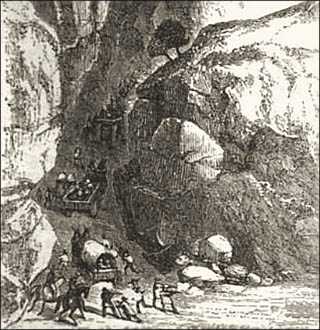
Among the many extraordinary chapters in the history of the Nineteenth Century none will seem in the next age more incredible and curious than that in which is related the Rise and Progress of Mormonism. The creed of the Latter Day Saints, as they style themselves, is not, indeed, more absurd and ridiculous than that of the Millerites, but this last sect had but a very brief existence, and is now almost forgotten; while the imposture of Smith and his associates, commencing before Miller began his prophecies, is still successful, and represented by missionaries in almost every state throughout the world. 578 THE INTERNATIONAL MAGAZINE. It has been observed with some reason, that had a Rabelais or a Swift told the story of the Mormons under the veil of allegory, the sane portion of mankind would probably have entered a protest against the extravagance of the satirist. The name of the mock hero, his own and his family's ignorance and want of character, the low cunning of his accomplices, the open and shameless vices in which they indulged, and the extraordinary success of the sect they founded, would all have been thought too obviously conceived with a view to ludicrous effects. Yet the Mormon movement has assumed the condition of an important popular feature, and after much suffering and many reverses, its authors have achieved a condition of eminent industrial prosperity. In twenty years the company, consisting of the impostor and his father and brother, has increased to nearly half a million; they occupy one of the richest portions of this continent, have a regularly organized government, and are represented in the Congress of the United States by a delegate having all the powers usually conferred on the members for territories. With missions in every part of the country, in every capital of Europe, in Mecca, in Jerusalem, and among the islands of the Pacific and the Indian Oceans, all of whom are charged with the duty of making converts and gathering them to the Promised Land of Deseret, they must very soon have a population sufficiently large to claim admission as an equal member to the Union, and perhaps to hold the balance of power in its affairs. To illustrate the energy and success with which their missions are prosecuted, we may cite the statement contained in a work just published in London, The Mormons, or Latter Day Saints, a Contemporary History, that more than fourteen thousand persons have left Great Britain since 1840 for the "Holy City." The emigrants passing through Liverpool in 1849, amounted to 2,500, generally of the better class of mechanics and farmers, and it was estimated that at least 30,000 converts remained behind. In June, 1850, there were in England and Scotland, 27,863, of whom London contributed 2,529; Liverpool, 1,018; Manchester, 2,787; Glasgow, 1,846; Sheffield, 1,920; Edinburgh, 1,331; Birmingham, 1,909; and Wales, 4,342. And the Mormon census was again taken last January, giving the entire number in the British Isles at 30,747. In fourteen years, more than 50,000 had been baptized in England, of whom nearly 17,000 had "emigrated to Zion." Although the Mormon emigration is commonly of the better class, there are also poor Mormons; and that these as well as their more prosperous brethren may be "gathered to the holy city," there is now amassed in Liverpool a very large fund, under the control of officers appointed by the "Apostles," destined exclusively for the equipment and transportation of converts to their place of Refuge. The interest which recent events have attracted to the community in Deseret or Utah, will render interesting a more particular survey of its origin, progress, and condition. In 1825 there lived near the village of Palmyra, in New-York, a family of small farmers of the name of Smith. They were of bad repute in the neighborhood, notorious for being continually in debt, and heedless of their business engagements. The eldest son, Joseph, says one of his friends, "could read without much difficulty, wrote a very imperfect hand, and bad a very limited understanding of the elementary rules of arithmetic.'' Associated in some degree with Sidney Rigdon, who comes before us in the first place as a journeyman printer, he was the founder of the new faith. The early history of the conspiracy of these worthies is imperfectly known; but it is evident that Rigdon must have been in Smith's confidence from the first. Rigdon, indeed, probably had more to do with the matter than even Smith; but it was the latter who was first put conspicuously forward, and who managed to retain the pre-eminence. The account of the pretended revelation, as given by Smith, is as follows: He all at once found himself laboring in a state of great darkness and wretchedness of mind -- was bewildered among the conflicting doctrines of the Christians, and could find no comfort or rest for his soul. In this state, he resorted to earnest prayer, kneeling in the woods and fields, and after long perseverance was answered by the appearance of a bright light in heaven, which gradually descended until it enveloped the worshipper, who found himself standing face to face with two supernatural beings. Of these he inquired which was the true religion? The reply was, that all existing religions were erroneous, but that the pure doctrine and crowning dispensation of Christianity should at a future period be miraculously revealed to himself. Several similar visitations ensued, and at length he was informed that the North American Indians were a remnant of Israel; that when they first entered America they were a powerful and enlightened people; that their priests and rulers kept the records of their history and doctrines, but that, having fallen off from the true worship, the great body of the nation were supernaturally destroyed -- not, however, until a priest and prophet named Mormon, had, by heavenly direction, drawn up an abstract of their records and religions opinions. He was told that this still existed, buried in the earth, and that he was selected as the instrument for its recovery and manifestation to all nations. The record, it was said, contained many prophecies as to these latter days, and instructions for the gathering of the saints into a temporal and spiritual kingdom, preparatory to the second coming of the Messiah, which was at hand. After several very similar visions, the spot in which the book lay buried was disclosed. Smith NAUVOO AND DESERET. 579 went to it, and after digging, discovered a sort of box, formed of upright and horizontal flags, within which lay a number of plates resembling gold, and of the thickness of common tin. These were bound together by a wire, and were engraved with Egyptian characters. By the side of them lay two transparent stones, called by the ancients, "Urim and Thummim," set in "the two rims of a bow." These stones were divining crystals, and the angels informed Smith, that by using them he would be enabled to decipher the characters on the plates. What ultimately became of the plates -- if such things existed at all -- does not appear. They were said to have been seen and handled by eleven witnesses. With the exception of three persons, these witnesses were either members of Smith's family, or of a neighboring family of the name of Whitmer. The Smiths, of course, give suspicious testimony. The Whitmers have disappeared, and no one knows any thing about them. Another witness, Oliver Cowdrey, was afterwards an amanuensis to Joseph; and another, Martin Harris, was long a conspicuous disciple. There is some confusion, however, about this person. Although he signs his name, as a witness who has seen and handled the plates, he assured Professor Anthon that he never had seen them, that "he was not sufficiently pure of heart," and that Joseph refused to show him the plates, but gave him instead a transcript on paper of the characters engraved on them. It is difficult to trace the early advances of the imposture. Every thing is vague and uncertain. We have no dates, and only tlie statements of the prophet and his friends. Meantime, Smith must have worked successfully on the feeble and superstitious mind of Martin Harris. This man, as we have just said, received from him a written transcript of the mysterious characters, and conveyed it to Professor Anthon, a competent philological authority. Dr. Anthon's account of the interview is one of the most important parts of the entire history. Harris told him he had not seen the plates, but that he intended to sell his farm and give the proceeds to enable Smith to publish a translation of them. This statement, with what follows, shows that Smith's original intention, quoad the alleged plates, was to use them as a means for swindling Harris. The Mormons have published accounts of Professor Anthon's judgment on the paper submitted to him, which he himself states to be "perfectly false." The Mormon version of the interview represents Dr. Anthon "as having been unable to decipher the characters correctly, but as having presumed that, if the original records could be brought, he could assist in translating them." On this statement being made, Dr. Anthon described the document submitted to him as having been a sort of pot-pourri of ancient marks and alphabets. "It had evidently been prepared by some person who had before him a book containing various alphabets; Greek and Hebrew letters, crosses and flourishes, Roman letters, inverted or placed sideways, were arranged in perpendicular columns, and the whole ended in a rude delineation of a circle, divided into various compartments, decked with numerous strange marks, and evidently copied after the Mexican Calendar given by Humboldt, but copied in such a way as not to betray the source whence it was derived." This account disposes of the statement that the characters were Egyptian, while the very jumble of the signs of different nations, languages, and ages, proves that the impostor was deficient both in tact and knowledge. The scheme seems to have been, at all events, inpetto when Smith communicated with Harris; but a satisfactory clue to the fabrication is lost in our ignorance of the time and circumstances under which Smith and Rigdon came together. It must have been subsequent to that event that the "translation," by means of the magic Urim and Thummim, was begun. This work Smith is represented as having labored at steadily, assisted by Oliver Cowdrey, until a volume was produced containing as much matter as the Old Testament, written in the Biblical style, and containing, as Smith said the Angel had informed him, a history of the lost tribes in their pilgrimage to and settlement in America, with copious doctrinal and prophetic commentaries and revelations. The devotion of Harris to the impostor secured a fund sufficient for defraying the cost of printing the pretended revelation, and the sect began slowly to increase. The doctrines of Smith were not at first very clearly defined; it is probable that neither he nor Rigdon had determined what should be their precise character; but like their early contemporary the prophet Matthias (the interesting history of whose career was published in New-York several years ago by the late Colonel Stone), they had no hesitation in deciding on one cardinal point, that the revelations made to Smith at any time should be received with unquestioning and implicit faith, and the earliest of these revelations contemplated a liberal provision for all the prophet's personal necessities. Thus, in February, 1831, it was revealed to the disciples that they should immediately build the prophet a house; on another occasion it was enjoined that, if they had any regard for their own souls, the sooner they provided him with food and raiment, and every thing he needed, the better it would be for them; and in a third revelation, Joseph was informed that "he was not to labor for his living." All these "revelations" were received, and though the impostor seemed to intelligent men little better than a buffoon, his followers soon learned to regard him as almost deserving of adoration, and he began to revel in whatever luxury and profligacy was most 580 THE INTERNATIONAL MAGAZINE. agreeable to his vulgar taste and ambition. As in the case of the scarcely more respectable pretender, Andrew Jackson Davis, it was asserted that his original want of cultivation precluded the notion of his having by the exercise of any natural or acquired faculties produced his "revelations." Everywhere his followers said, "The prophet is not learned in a, human sense: how could he have become acquainted with all the antiquarian learning here displayed, if it were not supernaturally communicated to him?" But to this question there was soon an answer equally explicit and satisfactory. The real author of the Book of Mormon was a Rev. Solomon Spaulding, who wrote it as a romance. Its entire history and the means by which it came into the possession of Smith are described, in the following statement, by Mr. Spaulding's widow: -- "Since the Book of Mormon, or Golden Bible (as it was originally called), has excited much attention, and is deemed by a certain new sect of equal authority with the sacred Scriptures, I think it a duty to the public to state what I know of its origin.... Solomon Spaulding, to whom I was married in early life, was a graduate of Dartmouth college, and was distinguished for a lively imagination, and great fondness for history. At the time of our marriage, he resided in Cherry Valley, New-York. From this place, we removed to New Salem, Ashtabula County, Ohio, sometimes called Conneaut, as it is situated on Conneaut Creek. Shortly after our removal to this place, his health failed, and he was laid aside from active labors. In the town of New Salem there are numerous mounds and forts, supposed by many to be the dilapidated dwellings and fortifications of a race now extinct. These relics arrest the attention of new settlers, and become objects of research for the curious. Numerous implements were found, and other articles evincing skill in the arts. Mr. Spaulding being an educated man, took a lively interest in these developments of antiquity; and in order to beguile the hours of retirement, and furnish employment for his mind, he conceived the idea of giving an historical sketch of the long-lost race. Their antiquity led him to adopt the most ancient style, and he imitated the Old Testament as nearly as possible. His sole object in writing this imaginary history was to amuse himself and his neighbors. This was about the year 1812. Hull's surrender at Detroit occurred near the same time, and I recollect the date well from that circumstance. As he progressed in his narrative, the neighbors would come in from time to time to hear portions read, and a great interest in the work was excited among them. It claimed to have been written by one of the lost nation, and to have been recovered from the earth; and he gave it the title of 'The Manuscript Found.' The neighbors would often inquire how Mr. Spaulding advanced in deciphering the manuscript; and when he had a sufficient portion prepared, he would inform them, and they would assemble to hear it read. He was enabled, from his acquaintance with the classics and ancient history, to introduce many singular names, which were particularly noticed by the people, and could be easily recognized by them. Mr. Solomon Spaulding had a brother, Mr. John Spaulding, residing in the place at the time, who was perfectly familiar with the work, and repeatedly heard the whole of it From New Salem we removed to Pittsburgh, in Pennsylvania. Here Mr. Spaulding found a friend and acquaintance, in the person of Mr. Patterson, an editor of a newspaper. He exhibited his manuscript to Mr. Patterson, who was much pleaded with it, and borrowed it for perusal. He retained it a long time, and informed Mr. Spaulding that if he would make out a title-page and preface, he would publish it, and it might be a source of profit This Mr. Spaulding refused to do. Sidney Rigdon, who has figured so largely in the history of the Mormons, was at that time connected with the printing office of Mr. Patterson, as is well known in that region, and, as NAUVOO AND DESERET. 581 Rigdon himself has frequently stated, became acquainted with Mr. Spaulding's manuscript, and copied it. It was a matter of notoriety and interest to all connected with the printing establishment. At length the manuscript was returned to its author, and soon after we removed to Amity, Washington county, where Mr. Spaulding died, in 1816. The manuscript then fell into my hands, and was carefully preserved. It has frequently been examined by my daughter, Mrs. M'Kenstry, of Monson, Massachusetts, with whom I now reside, and by other friends. After the Book of Mormon came out, a copy of it was taken to New Salem, the place of Mr. Spaulding's former residence, and the very place where the 'Manuscript Found' was written. A woman appointed a meeting there; and in the meeting read copious extracts from the Book of Mormon. The historical part was known by all the older inhabitants, as the identical work of Mr. Spaulding, in which they had all been so deeply interested years before. Mr. John Spaulding was present, and recognized perfectly the production of his brother. He was amazed and afflicted that it should have been perverted to so wicked a purpose. His grief found vent in tears, and he arose on the spot, and expressed to the meeting his sorrow that the writings of his deceased brother should be used for a purpose so vile and shocking. The excitement in New Salem became so great, that the inhabitants had a meeting, and deputed Dr. Philastus Hurlbut, one of their number, to repair to this place, and to obtain from me the original manuscript of Mr. Spaulding, for the purpose of comparing it with the Mormon Bible -- to satisfy their own minds and to prevent their friends from embracing an error so delusive This was in the year 1834. Dr. Hurlbut brought with him an introduction and request for the manuscript, which was signed by Messrs. Henry, Lake, Aaron Wright, and others, with all of whom I was acquainted, as they were my neighbors when I resided at New Salem. I am sure that nothing would grieve my husband more, were he living, than the use which has been made of his work. The air of antiquity which was thrown about the composition doubtless suggested the idea of converting it to the purposes of delusion. Thus, an historical romance, with the addition of a few pious expressions, and extracts from the sacred Scriptures, has been construed into a new Bible, and palmed off upon a company of poor deluded fanatics as Divine." Similar evidence as to the Spaulding MS. was given by several private friends, and by the writer's brother, all of whom were familiar with its contents. The facts thus graphically detailed have of course been denied, but have never been disproved. Indeed, without them it is impossible to explain the hold which Rigdon always possessed on the Prophet; for he was a poor creature, without education and without talents. At one time -- a critical moment in the history of the new church -- a quarrel arose between the accomplices; but it ended in Smith's receiving a "revelation," in which Rigdon was raised by divine command to be equal with himself, having plenary power given to him to bind and loose both on earth and in heaven. The remaining history of the Mormons is eminently interesting. Ignorant and superstitious as have been the chief part of the disciples, and atrocious as have been the tricks of the knaves who have led them on amid all the varieties of their pood and evil fortune, there have occasionally been displayed among them an enthusiasm and bravery of endurance that demand admiration. Nearly from the beginning the leaders of the sect seem to have contemplated settling in the thinly populated regions of the western states, where lands were to be purchased for low prices, and after a short residence at Kirtland, in Ohio, they determined to found a New Jerusalem in Missouri. The interests of the town were confided to suitable officers, and Smith spent his time in travelling through the country and preaching, until the real or pretended immoralities of the sect led to such discontents that 582 THE INTERNATIONAL MAGAZINE. in 1839 they were forcibly and lawlessly expelled from the state. We are inclined to believe that they were not only treated with remarkable severity, but that there was not any reason whatever to justify an interferance in their affairs. From Missouri the saints proceeded to Illinois, and on the sixth of April, 1841, with imposing ceremonies, laid at their new city of Nauvoo the corner-stone of the Temple, * an immense edifice, without any architectural order or attraction, which in a few months was celebrated every where as not interior in size and magnificence to that built by Solomon in Jerusalem. Nauvoo is delightfully situated in the midst of a fertile district and a careful inquirer will not be apt to deny that it became the home of a more industrious frugal, and generally moral society, than occupied any other town in the state. Whatever charges were preferred against Smith and his disciples, to justify the outrages to which they were subjected, the history of their expulsion from Nauvoo is simply a series of illustrations of the fact that the ruffian population of the neighboring country set on foot a vast scheme of robbery in order to obtain the lands and improvements of the Mormons without paying for them. We have not room for a particular statement of the discontents and conspiracies which grew up in the city, nor for any detail of the aggressions from without. On the 27th of June, 1844, Joseph and Hyrum Smith were murdered, while under the especial protection of the authorities of the state. A writer in the Christian Reflector newspaper, soon after, observed of Joseph Smith: "Various are the opinions concerning this singular personage; but whatever may be thought inreference to his principles, objects, or moral character, all agree that he was a most remarkable man..... Notwithstanding the low origin, poverty, and profligacy of these mountebanks, they have augmented their numbers till more than 100,000 persons are now numbered among the followers of the Mormon Prophet, and they never were increasing so rapidly as at the time of his death. Born in the very lowest walks of life, reared in poverty, educated in vice, having no claims to even common intelligence, coarse and vulgar in deportment, the Prophet Smith succeeded in establishing a religious creed, the tenets of which have been taught throughout America; the Prophet's virtues have been rehearsed in Europe; the ministers of Nauvoo have found a welcome in Asia; Africa has listened to the grave sayings of the seer of Palmyra; the standard of the Latter Day Saints has been reared on the banks of the Nile; and even the Holy Land has been entered by the emissaries of this impostor. He founded a city in one of the most beautiful situations in the world, in a beautiful curve of the 'Father of Waters,' of no mean pretensions, and in it he had collected a population of twenty-five thousand, from every part of the world. The acts of his__________ * The temple was of white limestone, 128 feet long, 83 feet wide, and 60 feet high. Its style will be seen in the above engraving. It was destroyed by fire, on the 19th of November, 1848. The town of Nauvoo is now occupied by another class of socialists, the Icarians, under M. Cabet, of Paris.
NAUVOO AND DESERET.
583
life exhibit a character as incongruous as it is remarkable. If we can credit his own words and the testimony of eye-witnesses, he was at the same time the vicegerent of God and a tavern-keeper -- a prophet and a base libertine -- a minister of peace, and a lieutenant-general -- a ruler of tens of thousands, and a slave to all his own base passions -- a preacher of righteousness, and a profane swearer -- a worshipper of Bacchus, mayor of a city, and a miserable bar-room fiddler -- a judge on the judicial bench, and an invader of the civil, social, and moral relations of men; and, notwithstanding these inconsistencies of character, there are not wanting thousands willing to stake their souls' eternal salvation on his veracity. For might we know, time and distance will embellish his life with some new and rare virtues, which his most intimate friends failed to discover while living with him. Reasoning from effect to cause, we must conclude that the Mormon Prophet was of no common genius: few are able to commence and carry out an imposition like his, so long, and so extensively. And we see in the history of his success, most striking proofs of the credulity of a large portion of the human family."After some dissensions, in which the party of Brigham Young triumphed over that of Sidney Rigdon, the sect were reorganized and for some time were permitted quietly to prosecute their plans at Nauvoo. But early in 1846 they were driven out of their city and compelled in mid winter to seek a new home beyond the farthest borders of civilization. The first companies, embracing sixteen hundred persons, crossed the Mississippi on the 3d February, 1846, and similar detachments continued to leave until July and August, travelling by ox-teams towards California, then almost unknown, and quite unpeopled by the Anglo-Saxon race. Their enemies asserted that the intention of the Saints was to excite the Indians against the government, and that they would return to take vengeance on the whites for the indignities they had suffered. Nothing appears to have been further from their intentions. Their sole object was to plant their Church in some fertile and hitherto undiscovered spot, where they might be unmolested by any opposing sect. The war against Mexico was then raging, and, to test the loyalty of the Mormons, it was suggested that a demand should be made on them to raise five hundred men for the service of the country. They consented, and that number of their best men enrolled themselves under General Kearney, and marched 2,400 miles with the armies of the United States. At the conclusion of the war they were disbanded in Upper California. They allege that it was one of this band who, in working at a mill, first discovered the golden treasures of California; and they are said to have amassed large quantities of gold before the secret was made generally known to the "Gentiles.'' But faith was not kept with the Mormons who remained in Nauvoo. Although they had agreed to leave in detachments, as rapidly as practicable, they were not allbwed necessary time to dispose of their property; and 584 THE INTERNATIONAL MAGAZINE. in September, 1846, the city was besieged by their enemies upon the pretence that they did not intend to fulfil the stipulations made with the people and authorities of Illinois. After a three days' bombardment, the last remnant was finally driven out. The terrible hejira of the Mormon emigrants over the Rocky Mountains has been described by Mr. Kane of Philadelphia, in an interesting pamphlet, which is honorable to his own character for good sense and for benevolent feeling. No religious emigration was ever attended by more suffering, no emigration of any kind was ever prosecuted with more bravery. It resulted in the permanent establishment of the "Commonwealth of the New Covenant," in Utah, or Deseret, one of the most attractive portions of the interior of this Continent, near its western border. Of this territory Mr. Kane says: Deseret is emphatically a new country; new in its own characteristic features, newer still in its bringing together within its limits the most inconsistent peculiarities of other countries. I cannot aptly compare it to any. Descend from the mountains, where you have the scenery and climate of Switzerland, to seek the sky of your choice among the i many climates of Italy, and you may find welling out of the same hills the freezing springs of Mexico and the hot springs of Iceland, both together coursing their way to the Salt Sea of Palestine, in the plain below. The pages of Malte Brun provide me with a less truthful parallel to it than those which describe the Happy Valley of Ragselas or the Continent of Ballibarbi. The history of the Mormons has ever since been an unbroken record of prosperity. It has looked as though the elements of fortune, obedient to a law of natural re-action, were struggling to compensate their undue share of suffering. They may be pardoned for deeming it miraculous. But, in truth, the economist accounts for it all, who explains to us the speedy recuperation of cities, laid in ruin by flood, fire, and earthquake. During its years of trial, Mormon labor had subsisted on insufficient capital, and under many difficulties, but it has subsisted, and survives them now, as intelligent and powerful as ever it was at Nauvoo; with this difference, that it has in the mean time been educated to habits of unmatched thrift, energy, and endurance, and has been transplanted to a situation where it is in every respect more productive. Moreover, during all the period of their journey, while some have gained by practice in handicraft, and the experience of repeated essays at their various halting-places, the minds of all have been busy framing designs and planning the improvements they have since found NAUVOO AND DESERET. 585 opportunity to execute. Their territory is unequalled as a stock-raising country; the finest pastures of Lombardy are not more estimable than those on the east side of the Utah Lake and its tributary rivers, and it is scarcely less rich in timber and minerals than the most fortunate portions of the continent. From the first the Mormons have had little to do in Deseret, but attend to mechanical and strictly agricultural pursuits. They have made several successful settlements; the farthest north is distant more than forty miles, and the farthest south, in a valley called the Sanpeech, two hundred, from that first formed. A duplicate of the Lake Tiberias empties its waters into the innocent Dead Sea of Deseret, by a fine river, which they have named the Western Jordan. It was on the right bank of this stream, on a rich table land, traversed by exhaustless waters falling from the highlands, that the pioneers, coming out of the mountains in the night of the 24th of July, 1847, pitched their first camp in the Valley, and consecrated the ground. This spot proved the most favorable site for their chief settlement, and after exploring the whole country, they founded on it their city of the New Jerusalem. Its houses are diffused, to command as much as possible the farms, which are laid out in wards or cantons, with a common fence to each. The farms in wheat already cover a space nearly as large as Rhode Island. The houses of New Jerusalem, or Great Salt Lake City, as it is commonly called, are distributed over an area nearly as great as that of New York. The foundations have been laid for a temple more vast and magnificent than that which was erected at Nauvoo. The Deseret News, a paper established under the direction of the ecclesiastical authority came to us lately with several columns descriptive of the fourth anniversary celebration of the arrival of the disciples in their Promised Land. Since the preceding paragraphs were written some important information has been received from Utah, justifying apprehensions that the ambition of the chief of the sect, and territorial governor, Brigham Young, will be continually productive of difficulties. It appears that in consequence of his unwarrantable assumptions of authority, the larger and most respectable portion of the territorial officers, including B. O. Harris, Secretary of the Territory, G. K. Brandenburg, Chief Justice, E. P. Bracchas, Associate Justice, H. R. Day, Indian Agent, and Messrs. Gillette and Young, were preparing to leave for the Atlantic States. The particulars of the difficulty are not stated, but it is said that $20,000 appropriated by Congress for territorial purposes had been squandered by Young, and an attempt made by him to take $24,000 from the Treasurer, who refused, and applied to the Court to support him. This was done, and an injunction granted restraining the proceedings of the Governor. |
|
Littell's Living Age
(Boston & NYC: E. Littell) "Mormonism, part 1" "Mormonism, part 2" "Origin of the Mormon Imposture" Transcriber's Comments |
|
More Mormonism articles in The Living Age: 1840s articles
|
LITTELL'S LIVING AGE. - No. 530. - 15 July, 1854.
From The Edinburgh Review.
1. * Patriarchal Order, or Plurality of Wives. By ORSON SPENCER, Chancellor of the 100 M O R M O N I S M.
M O R M O N I S M. 101
102 M O R M O N I S M.
M O R M O N I S M. 103
104 M O R M O N I S M.
M O R M O N I S M. 105
106 M O R M O N I S M.
M O R M O N I S M. 107
108 M O R M O N I S M.
M O R M O N I S M. 109
110 M O R M O N I S M.
M O R M O N I S M. 111
112 M O R M O N I S M.
M O R M O N I S M. 113
114 M O R M O N I S M.
|
- 1852 -
- 1854 -
|
The Edinburgh Christian Magazine. -------------------------------------------------------------------------------------------------------------------- Vol. VI. Edinburgh, U. K., 1854. No. ? -------------------------------------------------------------------------------------------------------------------- [40]
THE MORMONITES;
When the pen of inspiration fell from the hand of the venerable John, an awful woe was pronounced on all who should add to the record of the will of God for man's salvation. Yet, from age to age, men have been made the dupes of religious impostors. It matters not how absurd and impious their pretended revelations may be; thousands have embraced their doctrines with fanatical zeal, and established churches which exist at the present day. Such a church is that of the Mormonites, or so called "Latter Day Saints." And as it now comprehends 350,000 members, -- as its agents are labouring, not only in America, where it originated, but in this and many distant lands, -- as their converts are enticed across the Atlantic by false and wicked promises, -- and as the rise and progress of Mormonism is one of the strangest pages in modern history, -- we introduce to the notice of our readers, -- I. The history of the Mormonites; and II. The claims of their new religion as a revelation from God. This paper we devote to -- I. THE HISTORY OF THE MORMONITES. In the year A.D. 1805, Joseph Smith was born. When a youth of fifteen years of age, he was notorious as a common swindler in Palmyra, a town of the State of New York, in America. Yet, at that early age, with little or no education, and winning his bread by fraudulent practices, he resolved to invent a new religion, and to claim the rank of the Moses or Mohammed of modern times. According to his own account, his mind was distracted with the number of conflicting religious sects; and not knowing which of these was the Church of God, he one day retired to a grove near his father's house, and prayed that God might lead him to join the true Christian Church. That, he confesses, was the first time in his life he had made an attempt to pray; and yet he had scarcely bent the knee, when a pillar of light descended from heaven, and filled the landscape with celestial glory. In the midst of this light, he tells us, he beheld two personages, whose glorious majesty defied description. But one of these addressed him, saying; "Joseph Smith! This is my beloved Son; hear Him!" Joseph then ventured to ask what religious sect he ought to join; and the same speaker declared that all existing sects were an abomination in his sight; and that, at a future period, he would reveal to his youthful servant the fulness of the Gospel. This was the first of a series of visions; for, in 1823, he declared that an angel appeared to him thrice in one night, and once again on the following day, informing him, that the great work preparatory to the second coming of Christ was now to be commenced; that "the Golden Bible," or "Book of Mormon," was deposited in the earth; and that he was to find it buried in the hill of Cumorah, near Palmyra, in the United States. In consequence of this revelation, Joseph dug up the box in which the writings were buried. But when about to examine its contents, the angel of the Lord appeared, shewed him Satan and his evil spirits, and filled him with the Holy Ghost!!! The box, however, was not consigned to his care till the autumn of 1827.When this famous ark was disinterred and opened, within it was found a volume of plates, having the appearance of gold. These plates were loosely bound together by several rings, and were covered with engravings in Egyptian characters. These Joseph could not decipher; but, along with the plates, he discovered a curious instrument, formed of two transparent stones, fixed within the rims of a bow, like a pair of enormous spectacles. These stones, which he calls "the Urim and Thummim," were used, he informs us, by the seers or prophets of ancient times; and by their assistance he interpreted the THE EDINBURGH CHRISTIAN MAGAZINE. 41 engravings on the golden plates!! The Book of Mormon, thus brought to light by successive visions, was found to contain the history of the ancient inhabitants of America. These it describes as a branch of the house of Israel, of whom the Red American Indians are still a remnant. It further declares, that their principal nations having fallen in battle, two or three centuries after the death of Christ, one of their prophets, named Mormon, engraved their history, doctrines, and prophecies, on plates of gold, as a new revelation of vital interest to the world at large in the latter days. What its doctrinal and prophetical contents are, need not here be specified; but we add that, after the death of Mormon, Moroni, his son, is represented as having buried the golden plates at Cumorath, in the year 420 of the Christian era. About this time, a simple farmer, named Martin Harris, lent Joseph Smith fifty dollars, and soon afterwards sold his farm to enable the pretended prophet to publish the Book of Mormon. In order to secure its extensive sale, a false report was spread that Professor Anthon, a distinguished scholar, had pronounced the engravings on the sacred plates to be really characters of the Egyptian language. Moreover, a declaration was published and signed by eight individuals, to the effect that they had seen the plates of the Mormon Bible; while Martin Harris, David Whitmer, and Oliver Cowdery -- whose vicious characters will hereafter be exposed -- signed and circulated a testimonial, affirming that an angel had shewed them the golden plates, and that the voice of God had commanded them to bear witness to this extraordinary fact. As a crowning and conclusive evidence of his heavenly mission, Smith himself asserted, with almost all the solemnity of an oath, that John the Baptist appeared to him and Oliver Cowdery; that he conferred upon them the priesthood of Aaron, and promised them also the priesthood of Melchizedck; and that he commanded them to baptize one another, as "priests of the Most High God." This, accordingly, they did with all due reverence, in 1829, when the Mormon impostor was twenty-four years of age. Imagining that matters were ripe at last for action, the new prophet went forth to preach a false and mongrel Christianity, -- dwelling especially on his own inspiration, on the forgiveness of sin by immersion in water, on the reign of his followers as the Latter Day Saints, and on their inheritance of the earth in temporal power and glory. Like Mohammed, he borrowed much from the sacred Scriptures, while he corrupted the truth by blasphemous additions, suited to the natural tastes and passions of men. Every comet and meteor -- every war or rumour of war -- every monstrous birth among the lower animals -- every public calamity by tempest, fire, or steamboat explosion, was set forth as a proof and warning of the predicted coming of Christ. Appealing thus to the lowest faculties of credulous and unprincipled men, this crafty impostor, in 1830, was followed as a prophet by thirty disciples. But, as his character was too notorious in Palmyra, he removed to Kirtland, in the State of Ohio, where he established a bank, a general store, and a tavern. As the bank, however, was nothing else than a swindling concern, he selected a place called Independence, in the State of Missouri, as the site of the New Jerusalem -- pretending that he did so by revelation from heaven! During the next two years he preached with success in various parts of the United States, till his impious doctrines, and certain charges brought against him by one of his chief disciples, led to his being stripped, tarred, and feathered, by a furious mob. Meantime, the Mormonites in Missouri excited the rage of the surrounding populace. Friends and foes alike accused them of communism in wives; and of boasting that the time was at hand when they would seize the country and exterminate their enemies by fire and sword. Inflamed by these reports, the people rose against them, and blood was shed. A massacre of twenty Mormonites led to the formation of a Mormon regiment, named the "Dannite Band," or destroying angels, who were bound by an oath to take 42 THE EDINBURGH CHRISTIAN MAGAZINE. vengeance on their adversaries at the bidding of the church. This impolitic step exasperated the public mind to tenfold fury; and, to escape a general onslaught, the Mormonites surrendered their arms, and engaged to quit Missouri for ever, for the neighbouring State of Illinois. Accordingly, they removed to Commerce, a village on the banks of the Mississippi; and as their numbers now amounted to 15,000 souls, their leaders resolved to build a city, which they called "Nauvoo," or "the Beautiful," and also "the Holy City." Here, at length, Joseph Smith enjoyed a short season of prosperity and peace. He was prophet, priest, and chief magistrate of the new community, and commander-in-chief of a body of militia, raised under the title of the Nauvoo Legion. When thus at the pinnacle of his power and greatness, he sent his missionary agents to England, and succeeded in presenting copies of the Mormon Bible to Queen Victoria and her royal consort! As another fruit of the prophet's zeal, the foundation of a gorgeous temple was laid in 1841, and finally built at a cost of a million dollars. It was styled the Temple of Zion -- being erected, according to Smith, in obedience to the last revelation which he pretended to receive from Heaven. The first stone was laid by the prophet himself, amid the carnal pomp of a procession of troops, and ladies on horseback, military music, and the shouts of assembled multitudes. Having reached the climax of his earthly grandeur, the power of the Mormon leader was so great, that he proclaimed himself candidate for the Presidency of the American States; but, like Jonah's gourd, which grew in a night and perished in a night, his life and greatness were drawing fast to a close; and we must ascribe his downfall to the spiritual pride and aggressive ambition of his followers, who arrogantly threatened their opponents with the judgments of God. Besides, the laws of the government were trampled under foot. Nauvoo waged constant war against nine surrounding counties. The governor of Missouri -- the old enemy of the Mormonites -- was nearly assassinated; and Smith was prosecuted for the crime. To crown the whole, Sydney Rigdon, his chief coadjutor, introduced the disgraceful doctrine of "spiritual wives," -- alleging that God authorized the saints to make other men's wives and daughters their lawful concubines!! This scandalous charge originated with Dr. Foster, a Mormonite, whose wife the prophet had tried to corrupt; and if we allude to such atrocious doctrines and practices, it is because silence here would be treachery to truth, and because this very matter led to the violent death of the Mormon impostor, and his favourite brother, Hyram Smith. For Dr. Foster, fired with revenge and indignation, published a newspaper, The Expositor, in Nauvoo itself; and in the opening number he copied the affidavits of sixteen women, who declared on oath that Joseph Smith and his friends had attempted to make them their "spiritual wives," with the special permission of Heaven. Thereon the council of the city denounced the Expositor a public nuisance; and a mob of fanatics razed the newspaper office to the ground, destroyed the printing presses, and made a bonfire of the papers and furniture. In consequence of this new outrage, Dr. Foster fled for his life to Carthage, and applied for a warrant against Joseph and Hyram Smith. The warrant was granted; but the brothers refused to surrender themselves, till the magistrates prepared to besiege Nauvoo. On the evening of the 27th of June 1844, a ruffian mob, with blackened faces, attacked the prison, and fired on the brothers Smith, and two of their friends, who had paid them a visit. Hyram was slain in the place of confinement; and Joseph, after leaping from a window, was pierced by four bullets as he lay in a fainting state against a wall. Thus fell this extraordinary man. He was a criminal indeed in the sight of the law, but the victim of popular rage and violence. The perpetrators of his cruel murder were never discovered; and though they had been brought to justice, their death on the scaffold could not have prevented the deplorable consequences of their crime. For the death THE EDINBURGH CHRISTIAN MAGAZINE. 43 of the wretched impostor did more for his church than fifty years of his life could possibly have accomplished. His disciples regarded him as a martyr for the faith. Both friends and foes foretold that his crimes would be forgotten, and his cause promoted by his melancholy fate. And the prophecy was fulfilled; though not till the Mormonites had suffered another and severer period of suffering, provoked by their own vainglory and infatuation.
W. L. W.
(To be continued.)
In our last Number we sketched the history of this modern sect down to the death of Joseph Smith. On their subsequent movements we will not dwell, as the main interest of their progress terminates with the death of the arch-impostor. A few sentences, however, we must devote to -- THE MORMON EXODUS TO UTAH. After the solemn funeral of the prophet, Sydney Rigdon aspired to be chief of the Mormon Church. But he was ignominiously excommunicated, and "handed over to the buffetings of Satan;" and Brigham Young was elected successor to the departed "prophet." As the86 THE EDINBURGH CHRISTIAN MAGAZINE. latter had rashly predicted, that at Nauvoo "the saints" were to dwell for ever, the building of the temple of Zion was carried on, and the city was named "The City of Joseph." But once more his disciples indulged in threats against the neighbouring states and counties; pitched battles were fought, Nauvoo was besieged and taken by storm, and in 1846 its citizens commenced their pilgrimage across the Rocky Mountains to the unknown wilderness of New California, leaving their temple to be gutted by fire, and demolished by a furious hurricane. The distance travelled was 1200 miles. The perils by the way were great. The bones of thousands still whiten the prairies. Famine, plague, and Indian hostility, thinned their ranks. But, at last, they arrived at the valley of the Great Salt Lake in 1847 and 1848 -- a territory including the said "Dead Sea," the "Sea of Galilee," and the "Western Jordan," on the banks of which they have founded the "New Jerusalem." No sooner, however, had they seen their first crops waving, like a fair oasis in the desert, than a new calamity threatened the settlers with death by famine. Myriads of wingless locusts, black, hideous, and mounted on "legs of steelwire and lock-spring," descended from the mountains, and marched, in desolating nests, to devour the rising grain. Against this plague the Mormonites fought and prayed in vain, till flocks of sea-gulls arrived from the western coast, and gorged themselves on the invading foe. This danger passed, a greater threatened to disperse and overthrow the Mormon community. This was the discovery of gold in California by some of their own exploring bands; but, by published appeals, incessant preaching, and dire denunciations against the lust for "filthy lucre," the great mass of "the saints" remained in Utah, inclosing their farms, building houses, and making arrangements for gaining admission as a new state in the American Union. Accordingly, they now occupy a tract of country, locked in by lakes and mountains, at the height of upwards of 4000 feet above the level of the sea. This region is bounded on the west by the state of California; on the north, by the territory of Oregon; and on the east and south by the ridge of hills which separate the waters flowing into the Great Basin from those flowing into the Colorado River and the Gulf of California. In 1850, the American Government appointed Mr. Brigham Young the governor of this new state, with a staff of seven subordinate officers, of whom four are members of the Mormon Church. As, however, the Mormonites in Utah could not be recognized as an organized state till their population amounted to 60,000, the most desperate exertions have been made to "gather the saints from the ends of the earth to the land of promise," This is the secret spring of their missionary enterprise, which the gold of California enables them to prosecute, and whose rapid success is attributed to the lying wonders, and alluring bribes held out to ensnare the poorer classes in Christian lands. We now proceed to examine --
II. The Claims Of The Mormon Religion to be
1st, The character of the Mormon prophet. This is a point of paramount importance; for Joseph Smith pretended to converse with God and angels, inculcated doctrines inconsistent with our Christian faith, and proclaimed himself an inspired and "chosen servant of the Most High God, and equal with the Saviour of the world!" Now, as we are commanded to THE EDINBURGH CHRISTIAN MAGAZINE. 87 "try the spirits whether they be of God," and as Christ himself authorizes us to test and know them "by their fruits," it is no presumption, but a solemn duty, to inquire, whether the Mormon prophet was a man of God, like Moses, the prophets, and apostles; or a crafty deceiver, a daring blasphemer, and a sordid, sensual, ambitious profligate. In his youth, as we hinted in our former article, Smith gained a precarious living by gross and shameful imposition. On the testimony of his father-in-law and other parties, he pretended to possess a magical stone, by means of which he could discover gold and silver mines, and hidden treasure. Some were credulous enough to believe in his enchantments; and while his dupes were digging for the precious metal, he enticed them to pay him for his share, and left them to seek the imaginary spoil. This, however, seems not to have proved a lucrative trade; for, having resolved to elope with Miss Hale, the daughter of a Presbyterian clergyman, and being destitute of funds with which to effect his purpose, he persuaded a Mr. Stowell that he had discovered a bar of gold in a cave, and offered to share it with him for a sum of money. The trick succeeded. Its author fled with his bride to Manchester, an American town, and left his victim to lament his cupidity and infatuation. Such was his infamous mode of life in early manhood: and that this was a matter of notoriety, is proved by the following declaration, signed at Palmyra, Dec. 4th, 1833, by fifty-two influential citizens: -- "We, the undersigned, having known the Smith family for many years, have no hesitation in saying that they are destitute of moral character. Joseph Smith, the prophet, was, in particular, entirely destitute of moral character, and addicted to vicious habits." Nor did this wretched man discontinue his fraudulent practices after he claimed a mission from God as the prophet of the latter days. Removing from his native place, he commenced a system of wholesale swindling, by establishing a bank at Kirtland, in Ohio. For obvious reasons, however, a charter having been refused by the Government, some individuals who had accepted Smith's bank-notes, became anxious to learn what amount of precious metal "the company" possessed. In anticipation of this demand, Smith filled a box with 1000 dollars, and two hundred similar boxes with heavy rubbish. Each of these was marked in front, "1000 dollars;" and when the pretended prophet coolly opened the single box which was filled with silver coin, his creditors felt ashamed to prosecute their inquiry, and retired, imagining that the bank was solvent. This base deception was carried on till the public were robbed to the amount of 100,000 dollars. But, at last, the bubble burst, and the fraud exploded. The "prophet" was condemned as a fraudulent bankrupt in open court; but he fled with his booty, pursued by the officers of justice till he crossed the boundary of the state, and joined his disciples in Missouri! These facts may render it unnecessary here to expose Smith's deliberate lies and impious blasphemy, in pretending to receive revelations from Heaven commanding the people to provide him with a house, food, clothing, and their wives and daughters as his concubines! Indeed, on such "revelations" we could not dwell without polluting these pages; for they bear on their front the stamp of intense selfishness, gross sensuality, and atrocious wickedness; so that, were the founder of the Mormonites tried by his so-called "revelations" alone, they would convict him (to quote the words of his reverend father-in-law) as the author of fabrications "got up for speculation, that he might live on the spoil of those who swallowed the deception." Suffice it that we notice another feature of his character, -- insatiable ambition. The following is a copy of an affidavit, sworn to by Thomas March, a Mormonite, and confirmed on oath by Orson Hyde, an ex-apostle of the Mormon Church: -- "The plan of Joseph Smith is to take the state of Missouri, the United States, and ultimately the whole world. I have heard him say that he would yet tread down his enemies, and that he would make it one gore of blood from the Rocky Mountains to the Atlantic Ocean: for, as Mohammed's motto in treating for 88 THE EDINBURGH CHRISTIAN MAGAZINE. peace was: 'The Alcoran, or The Sword!' so it would be eventually with us: 'Joseph Smith, or The Sword!'" We close this sketch of the American impostor with two testimonials of his flagitious character. The first is extracted from a letter addressed to himself by Professor Turner of Illinois: -- "I have charitably sought to find some ground for believing that you and your comrades were only a new species of religious maniacs; but I have sought in vain. After a thorough examination of your career, a man might as well attempt to believe your religion, as to regard yourself in any other light than that of a deliberate, cold-blooded, persevering deceiver!" His moral deformity is thus portrayed in the Christian Instructor, a highly respectable American periodical: -- "If we can credit his own words, and the testimony of eye-witnesses, he was, at the same time, the vicegerent of God and a tavern-keeper -- a prophet of Jehovah and a base libertine -- a minister of the religion of peace and a lieutenant-general -- a ruler of tens of thousands and a drunkard, a profane swearer, and a slave to all his own base and unbridled passions!!" 2d, The real origin and history of the Book of Mormon. The first idea of the "Golden Bible" occurred to Smith after he heard that such a book had been found in Canada. According to the evidence of Peter Ingersol, one of his intimate friends, given on solemn oath, Smith had found some strange white sand, and took it home, wrapped up in his frock. On his friends inquiring what his frock contained, he answered in jest: "It is the Golden Bible; but no man can see it with the naked eye and live!" To his own surprise, they superstitiously believed him; and he afterwards said to his friend already referred to: "I have got the cursed fools fixed, and I'll carry out the fun!" Here, then, we have the germ of the Mormon imposture. Like the spider hungering for the blood of his victims, this cunning and unprincipled youth set his brain to work, and wove a web of ingenious falsehood, light as gossamer to an intelligent Christian, but strong as chains of steel to the ignorant and carnal-minded sinner. In other words, for the sake of money and sensual gratification, this common swindler speculated on the credulity and depravity of his fellow-men, and invented the story of the golden plates, covered with Egyptian characters, and interpreted by means of the gigantic crystal stones, "the Urim and Thummim!" Here we need not dwell on the fact, that God of old revealed His will to prophets and apostles, not by means of parchment, golden plates, or any engravings on material tablets, but by the inspiration of the Holy Ghost. But we must observe, that the "Urim and Thummim" were not spectacles, nor instruments used in the interpretation of written language, hut mysterious component parts of the dress of the Hebrew high priests. Be it also remembered, that the Mormon "prophet" was totally ignorant of the Egyptian language and characters; for when the Rev. Henry Caswell shewed him a Greek psalter, he pronounced it "a dictionary of Egyptian hieroglyphics!!" "But," asked Professor Caswell, "does it not look like Greek?" "No," answered Smith, who claimed the miraculous "gift of tongues;" "it ain't Greek at all, except perhaps a few words. What ain't Greek is Egyptian; and what ain't Egyptian is Greek!" In fact, the truth of the matter appears to be, that the golden plates never had existence; for no man, Mormonite or Christian, ever enjoyed the privilege of seeing them! True, Smith declared in "the Book of Mormon," that he was permitted to shew them to three individuals. But these very men at first confessed "that they saw them with the eye of faith alone, while the plates were concealed from bodily vision." True, moreover, a copy of some of the golden plates was brought by Martin Harris to Professor Anthon; but that learned scholar declares, that the whole affair was a scandalous hoar, and that the engravings were a wretched forgery, borrowed from the Roman, Greek, and Hebrew alphabets, and Humboldt's Mexican Calendar!" Though the prophet's witnesses at first acknowledged that they had never seen THE EDINBURGH CHRISTIAN MAGAZINE. 89 the plates with the bodily eye, they subsequently published a declaration, in which they stated: "That an angel from heaven brought the plates unto them; and that these plates were shewn unto them by the power of God, and not of man." Therefore the character and credibility of these three witnesses become a question of vital importance. Their names are Oliver Cowdery, David Whitmer, and Martin Harris. First of all, as to Oliver Cowdery. Joseph Smith himself published the following "revelation" against him in A.D. 1831: "Hearken unto me, saith the Lord your God; it is not wisdom in me that Oliver Cowdery Be Entrusted With The Monies which he shall carry into the land of Zion, unless one go with him who shall be true and faithful." Again, as to David Whitmer. In a paper drawn up by Sidney Rigdon, and signed by eighty-four Mormonites, it is stated that the said D. Whitmer and O. Cowdery, were members of "a gang of counterfeiters, thieves, liars, and blacklegs of the deepest die," combining to "cheat and defraud the saints of their property." Once more, as to Martin Harris. He had sold his farm to enable Smith to publish the Book of Mormon; but his wife bore witness, that when she strove to convince him of Smith's imposition, he doggedly replied: "What if it is a lie f If you let us alone, I will make money by it!" But not only was this witness a Mormonite for filthy lucre's sake, -- Professor Turner testifies that he was "a domestic tyrant, frequently beating and kicking his patient wife;" and when he seceded from the Mormon Church, denouncing Smith as "a perfect wretch," his master repaid the compliment by describing him in one of his journals as "a negro with a white skin, so far beneath contempt, that a notice of him would be too great a sacrifice for a gentleman to make!" Such were the men who declared that they had seen and handled the golden plates. They were leading office-bearers in the Mormon Church; yet, on the testimony of their own friends and fellow-impostors, they were arrant knaves, and utterly unworthy of belief. But, still it may be asked, how an uneducated man like Joseph Smith could compose such a work as the Book of Mormon? Our answer is, that he was not its author -- that in this respect, as in other matters, he was convicted of theft and falsehood; and that this new charge is established by a chain of evidence as clear, unbroken, and condemnatory, as ever was heard in a court of justice. In 1812, there lived in the town of New Salem, the Rev. Solomon Spaulding, who, in consequence of illness, had resigned his pastoral charge. To occupy his leisure hours, he spent three years in writing a historical romance, or rather a religious tale, representing the Red American Indians as the lost Ten Tribes of Israel. Its style was a studied imitation of that of the Old Testament histories. Its principal heroes were Mormon, and his son Moroni. As its author pretended that he had dug it up from an Indian mound, its title was "The Manuscript Found;" and Mr. Spaulding's wife, his brother John, and many of his friends and neighbours, heard it read from time to time. Soon afterwards, the Rev. Mr. Spaulding and his family removed to Pittsburg, where he lent the manuscript tale to Mr. Paterson, the editor of a newspaper; and thus it fell into the hands of Sidney Rigdon, who was a Baptist preacher, and a compositor in Mr. Paterson's printing-office; and who afterwards became the chief accomplice of Joseph Smith in founding the Mormon Church. As the author refused to publish the work, yet left it in Mr. Paterson's hands for a considerable time, S. Rigdon copied the M.S.; and after Mr. Spaulding's death in 1816, he lent it to Joseph Smith, who made it the groundwork of the celebrated "Book of Mormon." This was very providentially proved; for after the "Book of Mormon" was published, copious extracts from it were read by a female Mormon preacher in a public meeting held at New Salem, -- the very town where "The Manuscript Found" was written! At that meeting, Mr. John Spaulding, and certain of his friends were present; and the former at once recognized the extracts rend as stolen from his departed brother's work! Amazed at the strange discovery, and 90 THE EDINBURGH CHRISTIAN MAGAZINE. bursting into tears of grief and indignation, he rose and expressed his bitter sorrow at the writings of his brother being used for a purpose so vile and blasphemous. These withering facts he subsequently confirmed by his solemn oath; and thus, in the words of its author's widow, "A historical romance," with alterations and additions, has been converted into "a new Bible, and palmed off" on a sect of poor deluded fanatics as a divine revelation!"
W. T. W.
(To be concluded in our next Number.)
In examining the claims of Mormondom to be received as a revelation of the will of God, we have already considered, 1st, The character of its Founder; and, 2d, The real origin and history of the Book of Mormon. And the result of our inquiry was, that the character of Joseph Smith was a combination of knavery, ambition, sensuality, and impiety; -- and that the "Mormon Bible" was nothing else than Spaulding's historical romance, "The Manuscript Found," with such additions and alterations as might conceal its origin, and palm it off on the credulous multitude as a divine revelation. In further exposing this most transparent, but most dangerous imposture, let us glance -- 3d, At the literary and religious characteristics of the Book of Mormon. In defining the meaning of the word "Mormon," Smith unmasks his own unblushing impudence, and gives the world a ludicrous illustration of the proverb, that "a little learning is a dangerous thing." "The Bible," he tells us, "means good; for the Saviour says: 'I am the good Shepherd.' We say from the Saxon, good; from the Dane, god; the Goth, goda; the German, gut; the Dutch, goed; the Latin, bonus; the Greek, kalos; the Hebrew, tob; and the Egyptian, Mon. Hence, with the addition of more, or the contraction mor, we have the word Mor-Mon, which means, literally, More-Good." Here is a learned definition, which reminds us of Dr. Johnson's definition of higgledy-piggledy, -- "a conglomerated mass of heterogeneous matter!" Here is a man inspired to interpret tongues, blindly asserting that the word Bible means good! -- though every tyro in Greek knows that it signifies the book. Here is a pretended prophet who claims divine inspiration, and yet maintains that the name of Mormon, the Nephite prophet, who lived two centuries after the birth of Christ, is composed of the Saxon word more prefixed to the Egyptian word mon! But his definition was craftily invented to serve a purpose. He argued thus: -- "The very title of this book means More-Good, -- that is, more of the Gospel, -- a new Revelation for the Latter Days, equally genuine, authentic, and infallible, with the Gospel of Jesus Christ. As Christianity is the development of preceding dispensations, Mormonism is the development of Christianity; and I am the angel of the everlasting Gospel, whom John beheld, in vision, flying through heaven, to preach the fulness of the truth to every creature!" Now, as J. Smith acknowledged the Bible to be the Word of God, and as one of the articles of the Mormon creed is as follows: -- "We believe in the word of God recorded in the Bible, and also the word of God recorded in the Book of Mormon," -- we are entitled to expect that the latter volume contains no glaring errors, no rank absurdities, no anachronisms, no heresy whatsoever, nor the slightest inconsistency with the Old and New Testaments. This, we say, we are entitled to demand. As the colours of the rainbow blend and form a pure and dazzling light -- as the attributes of God harmonize, and constitute Him the all-perfect One -- as the books of nature, providence, and grace, illustrate and interpret heavenly truth -- and as Moses and the Prophets, and Christ and the Apostles, revealed the same great truths from age to age, as inspired and infallible teachers sent by God, -- this book of Mormon, if it is the Word of God, must be free from human errors, and must bear the impress of its divine original; -- in other words, it must harmonize with the sacred Scriptures, and communicate truths plainly and essentially necessary to man's salvation and the glory of God. 116 THE EDINBURGH CHRISTIAN MAGAZINE. Such portions of the Book of Mormon as remained as Mr. Spaulding wrote them, possess no inconsiderable literary merit, though he undertook the impracticable task of imitating the style of the Old Testament writings. Not so, however, with J. Smith, the "inspired interpreter of the golden plates." Wherever he altered Mr. Spaulding's romance, he betrays the cloven hoof of an impostor. He is the stone-mason replacing a limb on the Venus de Medici. He is a sign-painter restoring a masterpiece of Claude or Rembrandt. He is a schoolboy adding to the classic simplicity, and poetic grandeur, and heroic chivalry of Homer's Epics. Not to speak of his utter ignorance of Hebrew idioms, ellipses, and terse but comprehensive style, -- the Book of Mormon is full of grammatical blunders, so very shameful that the schoolmaster in America is evidently not abroad. Such phrases as these are of frequent occurrence: -- "I saith unto them," -- "I, who ye call your king," -- "Ye saith unto him," -- "Ye are like unto they," -- These things had not ought to be," -- "For a more history part are written on my other plates." How unlike the style of the shepherds and fishermen who wrote the books of the incomparable Bible! J. Smith was not inspired with chronological knowledge. He represents Mormon the prophet as guilty of anachronisms as absurd as those of any Arabian, Hindu, or Chinese pretender. The Book of Mormon relates, that the Nephites sailed by the guidance of the compass to America, more than a thousand years before that instrument was invented. It mentions our Saviour by the titles "Christ" and "Jesus;" whereas, had Mormon been a Hebrew, and the engraver of the so-called golden plates, he would have designated our Lord "Messiah" and "Joshua." It speaks of "Christians" centuries before the coming of Christ, though we know from Acts xi. 26, that "His disciples were called Christians first at Antioch," in A.D. 41. It represents the Israelites of the tribe of Joseph as using the Gospel ordinances and Christian sacraments many ages before the Mosaic law was abolished, or the Christian worship instituted in its stead. It even quotes Paul's Epistle to the Romans, (xi. 17, 19, 23,) some hundred years before Paul was born; and its compiler absurdly misapplies the terms "alpha" and "omega," as if he deemed them possessed of some mystic meaning, and as if he little imagined that they are the first and last letters of the Greek alphabet, and could have no place in a book so ancient, and composed by one whose mother tongue was Hebrew, and who engraved the reformed Egyptian characters on the golden plates. Such are a few of the anachronisms which prove the Book of Mormon an illiterate work of modern date. The mariner's compass in use in the days of the prophets! Christ, Christians, and Christian ordinances recorded by an ancient orthodox Jew! The Epistle to the Romans quoted before it was written! As well might this base fabrication speak of Knox and Luther, of railways to London, or the bombardment of Odessa; and, nevertheless, be held by its blasphemous author a divine revelation of the Gospel! Some of the stories of the Book of Mormon are sublimely ridiculous. The most fabulous writers of the Apocrypha would have rejected them. Mohammed would not have dared to insert them in the Alcoran. In the middle ages, some Romish monk might have penned them on the illuminated page of a book of holy legends. But, alas! for the light of the nineteenth century! -- Joseph Smith has given them a prominent place in "The Book of the New Everlasting Gospel!" Take the following specimen: -- When the Jaredites were about to emigrate to America, they built eight boats, "made like unto dishes." These vessels were air-light, and yet had a hole in the roof, (to admit fresh air?) and a hole in the bottom, (to admit salt water?) These extraordinary barges could swim on the sea, or dive to its channel, with equal ease. They had two windows each, formed of molten stones; and two of these windows were preserved, and became "the Urim and Thummiin" which J. Smith used as spectacles in translating the Golden Plates!! Strange, indeed, that THE EDINBURGH CHRISTIAN MAGAZINE. 117 men who laugh at Aesop's Fables, popish legends, and Gulliver's Travels, can credit such inventions as the Word God! Not unfrequently this spurious volume flatly contradicts the sacred Scriptures. We quote one instance, of itself sufficient to brand that volume as a wretched forgery, and its pretended author as a lying prophet: -- The sceptre was to continue in the tribe of Judah till Shiloh came, (Gen. xlix. 10;) but the Book of Mormon describes the descendants of Joseph as legitimate kings in Israel. It is equally certain that the priesthood was conferred on Aaron and his sons, (Num. iii. 10,) -- that the service of the sanctuary was imposed on the tribe of Levi, -- and that Jehovah threatened those who should usurp the priestly office with the doom of "Korah and his company," and sternly commanded that they should be "put to death." But of this fundamental law of the Mosaic economy the American "prophet" was profoundly ignorant. He represents Lehi and his sons, of the tribe of Joseph, as priests in accordance with the law of Moses; and, with a daring impiety, seldom heard of far from the Roman Vatican, he himself usurped the prophetical, priestly, and kingly offices of Jesus Christ! 4th, Heretical doctrines of the Mormonites. In addition to the Book of Mormon, Smith published a "Book of Doctrines and Covenants." His followers have published tracts, pamphlets, and series of essays, in explanation and defence of the Mormon creed. But as these remarks must be drawn to a close, we must not dwell on all their heresies, nor dare we glance at their vulgar and horrible notions of heaven and hell. They profess to believe in the Holy Bible; yet Orson Pratt, their English apostle, declares, that because they cleave to the Holy Bible, the whole Protestant clergy "are as destitute of the authority of God as the devil and angels!" "What, then, would this man have us to believe? In living prophets, apostles, and high priests, -- in the gift of tongues and modern miracles, -- in the baptism of the dead and baptismal salvation, -- in the divine right of revenge, fornication, and adultery, -- in the saintship of a monster of wickedness, -- in the divine original of a book formed out of a romance, and replete with errors, falsehoods, and blasphemies, -- and, of course, in his own infallibility, honesty, and worth, as an apostle to the Gentiles! The Mormonites teach the atheistical doctrine, that matter is eternal; -- in other words, they deny that "God created the heavens and the earth," -- the prima materia of the present universe. This dogma is so opposed to reason, science, and revelation, that we dismiss it with Dr. Adam Clarke's observation: "If there were an eternal Nature besides an eternal God, there must have been two self-existent, independent, and eternal Beings, which is a most palpable contradiction." They maintain that forgiveness of sins is obtained by immersion in water, apart from faith in the blood of Christ; and that sanctification begins in the soul, not at conversion, and by the immediate agency of the Holy Spirit, but by a sacramental process involved in "baptismal regeneration." They tell us that angels are human beings, -- that God is not a Spirit, but a man like ourselves, -- and that, in another world, man will be exalted above God! In proof of a statement so extraordinary, I quote the following from "the Millennial Star," Vol. VI., printed on the "Prophet's" authority, and signed by his own name: -- "The weakest child of God who now exists upon the earth will possess more dominion, more property, more subjects, more power and glory, than is possessed by Jesus Christ or by His Father! * * * What are angels? They are intelligences of the human species. Many of them are the offspring of Adam and Eve, -- of men, it is said, being gods, or sons of God, endowed with the same powers, attributes, and capacities, that their heavenly Father and Jesus Christ possess. * * * What is God? -- He is a material organized Intelligence, possessing both body and parts. He is in the form of a man, and is, in fact, of the same species, and is a model and standard of perfection, to which man 118 THE EDINBURGH CHRISTIAN MAGAZINE. is destined to attain. This Being cannot occupy two distinct places at once, therefore He cannot be everywhere present." Such gross infidelity, such hideous blasphemy, constrains us to ask: Did J. Smith ever read the Bible? If so, did he believe it? Was he inspired to contradict Jesus Christ's declaration, "God is a Spirit?" -- to contradict the Holy Ghost, who moved holy men of old to teach us that God is invisible, omnipresent, and enthroned "in light inaccessible and full of glory?" But our English Mormonites advance, if possible, further atill in frightful impiety, They insolently say, that the God whom Christians worship is "a newly-invented God, resembling nothing in heaven, or earth, or hell;" and that our worship of Him "far surpasses, in absurdity, the worship of frightful serpents, or images of wood, or stone, or brass!" It is exceedingly painful to quote these ravings of infidels, -- infidels more insane, and more inveterate in enmity to God than Paine, Voltaire, or Rosaeau! Yet thousands of our countrymen are forsaking the God of their fathers for a god who is a man, who eats and drinks, who sins and repents, who very little excels ordinary men in stature, and who knows nothing that is done under the sun, unless an angel ascends to heaven to inform him!! 5th, Prophecies and miracles are adduced in support of the Mormon imposture. When Mormonism was in its infancy, J. Smith predicted "by revelation from God," that Sidney Rigdon would live to accomplish "a great work" in advancing the kingdom of heaven. The revelation was falsified by the event. Rigdon was a scandal to the Mormon Church. His doctrine of "spiritual wives" led to the murder of "the prophet." And he himself was "handed over to Satan," by a public council of his fellow-apostles. In three distinct revelations, J. Smith foretold that Zion was to be built for ever at Independence in Missouri. Unfortunate prophet! his disciples were banished from Missouri, and founded Zion in New California! One prophecy, however, Smith was determined to fulfil. In 1841, he foretold that his old enemy, Governor Boggs, would die within a year. Mr. Bennet, the mayor of Nauvoo, deposed, that for a reward of 500 dollars, one of the Daoite band fired a shot at the governor, and soon after appeared in Nauvoo with abundance of money. Next day, the fulfilment of the prophecy was proclaimed on Smith's authority; but Governor Boggs survived the assassin's bullet, and within the year, actually assisted in bringing Smith himself to a premature death! As a worker of miracles, we need not say J. Smith was not more successful. When the Asiatic cholera broke out among his followers, he attempted to heal them by "laying on of hands and prayer;" and when he failed, he consoled them with the heartless assurance, that their enemies would suffer more than they by the deadly plague! On another occasion, he proclaimed his intention to walk across an American river, as a decisive proof of his being a prophet of God. The appointed day arrived. Multitudes were assembled. But, when on his way to the Mississippi, he stopped and refused to fulfil his promise, on the hypocritical pretence that many of the people had no faith! -- as if their conversion from unbelief were not the very end to be served by his working the miracle! At the present day, miraculous powers are claimed by the Mormon "prophets" and "apostles." A list of miracles has been published by the apostolic Orson Pratt. It rivals, but does not surpass, the catalogue of wondrous cures performed by "Parr's Life Pills," and such quack medicines. Can Pratt deny that several Mormonites died of cholera in Glasgow, because their apostles "cast physic to the dogs," and tried their miraculous gifts in vain? Can he deny that Cecilia Howe expired at Cardiff, after three days spent in vain attempts to cure her by a miracle, and fifteen minutes after a leading Mormonite declared she would not die? Can he deny that two "apostles" called a public meeting at Newport, to witness the raising of a man from the dead, -- that a gentleman present, suspecting conspiracy, inflicted a sound whipping on the pretended corpse, -- and that the latter rose and fled from THE EDINBURGH CHRISTIAN MAGAZINE. 119 the place in shame and terror? These are specimens of Mormon miracles! but they are not the most disgusting that might be referred to. In the following extract from the Millennial Star, published 1st Aug. 1847, a Mormon preacher gives an account of his casting out devils at the ordination of Richard Currell to the priesthood: -- "When we laid our hands upon him, the devil entered him, and tried to prevent us from ordaining him; but the power of Jesus Christ in the priesthood was stronger than the devil. When the devil found he was defeated in brother Currell, he entered a sister. The devils kept coming in for several hours. As fast as one lot was expelled, another lot entered. At one time, we counted twenty-seven come out of her. I may as well say, that the devils told us they were sent, some by Cain, and some by Kite, Kilo, Kelo, Kalmonia, Judas, and Lucifer. We cast them out thirty times, and had three hundred and nineteen devils, -- from three to thirty coming out at a time!!!" Surely such vulgar nonsense needs no comment. Impiety and impudence can go no farther. We only hope, that the man who wrote the foregoing report, may himself be exorcised from a spirit of falsehood, and that our countrymen may laugh to scorn such absurd and soul destructive delusions! We have written these articles on Mormonism for the special use of the working-men in town and country. The bait held out to them by lying emissaries, is not without its own peculiar allurements: "Become a Mormon; and we offer yon a western paradise -- rocks of gold -- land for nothing -- -freedom from jails, police, &c. -- 'perfect liberty' to desert wife and children in Britain, and to marry another woman, or any number of spiritual wives -- and, at the same time, pardon of sin by simple immersion in water!" Excepting, indeed, the Mormonite toleration of polygamy, these enticements are fallacious bribes. According to Kelly's "Excursions in California," the Mormon valley is a "bald and level plain, without bush or bramble to cast a shade from the scorching rays of a flaming sun." There is no crop there without toil and hardships; no gold at the diggings without labour, disease, and the probability of robbery, or even murder; no crime detected without "lynch law," or the more regular laws of the United States. A thousand times happier is life at home, or on the fields of Upper Canada, or the pastures of Australia! Nor should our countrymen forget, that Mormonism is a new form of foul and detestable infidelity. "The great danger is, that it is clothed in the garb of Christianity to deceive the unwary. It is a wolf in sheep's clothing. It is atheism in Bible-binding. It is Satan's brass with the name of the Saviour on it, to make it pass current, and deceive, corrupt, and destroy. It is a lie dressed up with a garnish stolen from the Word of God!" The sacred Scriptures, on the other hand, bear on every page the stamp of divine inspiration. They challenge investigation. They have triumphed over all the assaults of scepticism and false philosophy; and from every furnace of scorn and sophistry, they shall come forth refined, and more impressively than ever vindicate their claim to be, -- "The Word Of God." "Though we, or an angel from heaven, preach any other gospel unto you than that which we have preached unto you, -- let him be accursed!" What an inscription for the tomb of Joseph Smith! What an inspired apostolical anathema on him and all his preachers! What an argument in favour of the Christian clergy combining in a holy war against Mormon heresy, and blasphemy, and immorality, -- by lectures, tracts, pamphlets, and the organized visitation of the lanes and closes of our populous cities!
W. L. W.
|
- 1854 -
|
Arthur's Home Magazine (Philadelphia: T. S. Arthur & Co.) "Nauvoo, Illinois -- the Mormons" by Rev. John M. Peck See also Rev. Peck's 1835 article |
|
|
National Magazine (New York City: Carlton & Phillips.) "Nauvoo and Deseret" "Nauvoo and Deseret" Transcriber's Comments |
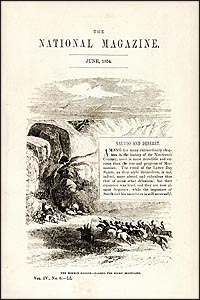
|
|
Church Review (New Haven: G. B. Bassett & Co.) "Utah and the Mormons" Transcriber's Comments |
|
|
CHURCH REVIEW. Vol. VIII. October, 1855. No. 3. Art. III. -- UTAH AND THE MORMONS. Utah and the Mormons. The History, Government, Doctrines, Customs and Prospects of the Latter Day Saints, from personal observation during a six months' residence at Great Salt Lake City. By BENJAMIN G. FERRIS, late Secretary of Utah Territory. New York, 1854. Harper & Brothers. 368 Utah and the Mormons [Oct.
1855.] Utah and the Mormons 369
370 Utah and the Mormons [Oct.
1855.] Utah and the Mormons 371
372 Utah and the Mormons [Oct.
1855.] Utah and the Mormons 373
374 Utah and the Mormons [Oct.
1855.] Utah and the Mormons 375
376 Utah and the Mormons [Oct.
1855.] Utah and the Mormons 377
378 Utah and the Mormons [Oct.
|
|
The Tribune Amanac (NYC: New York Tribune press) "Utah and the Mormons" A report compiled from 1857-59 articles from Horace Greeley's New York Tribune Transcriber's Comments |
|
|
The Atlantic Monthly (NYC: New York Tribune press) March - Part One April - Part Two May - Part Three Transcriber's Comments |
|
|
Transcriber's Comments
|
Back to top of this page
History Vault | Bookshelf | Spalding Library | Mormon Classics | Newspapers
HOME unOFFICIAL JOSEPH SMITH HOME PAGE CHRONOLOGY
last updated: Apr. 24, 2012