
|
Eduard Meyer (1855-1930) Ursprung und Geschichte der Mormonen (Halle: Niemeyer, 1912) From the English translation by Heinz F. Rahde & Eugene Seaich University of Utah, c. 1950 (no copyright notice attached) |
 Dr. Eduard Meyer (1855-1930) |
J. Adams' Birth of Mormonism 1916 | M. Werner's Brigham Young 1925
THE ORIGIN AND HISTORY OF THE MORMONS With reflections on the beginnings of Islam and Christianity by Eduward Meyer Translated by Heinz R. Rahde and Eugene Seaich Univerity of Utah Salt Lake City 12. Utah |
|
John Quincy Adams (1842-1940) The Birth of Mormonism (Boston: The Gorham Press, 1916) |
 |
|
[ 9 ]
10 THE BIRTH OF MORMONISM exercises to the glory of God; for "Pilgrims" (1817), who were led by an inspired prophet, and who made of raggedness and uncleanness a virtue, wearing their clothes unchanged as long as they would hold together; for Dylkes, "the Leatherwood God" (1828), who at an Ohio camp meeting, announced himself as the professed Messiah; for Jemimah Wilkinson, "the Universal Friend;" for William Miller and the end of the world, with proper ascension robes, and for Joseph Smith, Jr., and the Mormon Bible. This is not a complete catalogue of such movements during these years, and from such sowing we are still reaping a harvest. Of course this religious ferment had in it good as well as evil, but when we are tempted to sigh for "the good old days" of our fathers, we would do well to quit sighing and read some history. It is thought by many now that the early settlement of this part of the "West," (Western and Central New York) THE BIRTH OF MORMONISM 11 consisted only of God-fearing, man-loving men and women, with children just ripe for the Sunday School book, and that in these ways they are in contrast with the settlers of the West of these degenerate days. But if contemporary chronicles are to be believed, while "grace abounded" sin "did much more abound." Mormonism was, therefore, planted in fertile soil. The climate was favorable to its growth. The people delighted in humbuggery, and Joseph Smith is one of the high-priests of the art. "The First Church of Christ of Latter Day Saints" was organized April 6, 1830, at the house of Peter Whitmer, Fayette, Seneca County, N. Y., with six members. In the history of Mormonism this is its official birthday, corresponding to the Day of Pentecost in the Christian Church. Mormon historians describe the events of this day in glowing language. Orson Pratt subsequently figured out that it was just eighteen hundred years to 12 THE BIRTH OF MORMONISM a day since the resurrection of Jesus Christ. We shall find very often that Mormon Apostles, Priests and Prophets are surprisingly accurate in such matters! Like Pentecost this day does not dawn without a long process of preparation. We are here largely concerned with this preparatory work. In the first place we shall tell the life story of some of those who laid the foundations and are responsible for the beginnings of what has proved to be the most virile new religion which the fertile nineteenth century produced. Then we shall consider its sacred books, their character and origin. We begin, therefore, with "the Prophet, Seer and Revelator," the first President of the Church of Jesus Christ of Latter Day Saints, Joseph Smith, Jr. Sharon, Vt., has the honor of being the place, December 23, 1805, the date, where and when Joseph Smith, Jr., first saw the light. Cannon says: "His parents were toilers, THE BIRTH OF MORMONISM 13 their characters were godly, and their names unstained." Well known facts, however, scarcely sustain so favorable a judgment. Both parents were of Scotch descent. His father was ignorant, lazy, of not much account -- certainly not eminent for godliness, nor yet very bad. Like his illustrious son, the future "patriarch" of the Church was engaged in hunting for Captain Kidd's money -- certainly not an immoral occupation -- and was also charged, in company with Jack Downing, with making counterfeit money, but turned State's evidence and thus escaped punishment. Joe's mother, whom the prophet resembled, had more native wit and shrewdness than her husband, which stood her in place of "schooling." She was given to reveries and fortune telling, was possibly a fanatic rather than a fraud, but was a good teacher for her son. Joseph was the fourth of nine children, and his mother early decided, probably in view of his mental ability to deceive 14 THE BIRTH OF MORMONISM in which he resembled her, that he was destined for a distinguished career as a prophet, magician, fortune teller, discoverer of springs of water or gold mines, or some other equally honorable and lucrative occupation. In 1816, the family removed to Palmyra, N. Y., and two years and a half later to the town of Manchester. Here they squatted on a small farm, built a two-roomed log house, and lived until their fortunes were improved by the new religion, and they departed for Kirtland, Ohio. The universal testimony of those who knew them at this time is that the family were a lazy, illiterate, drinking, shiftless, good-for-nothing lot, having no regular occupation, doing everything by turns, and nothing long, and living largely off their neighbors, while Joe, whose besetting sin then, as later, was lying, was considered the most worthless of them all. When he learned to read nobody knows. His favorite poetry was the thrilling stanza: THE BIRTH OF MORMONISM 16 As I sailed, as I sailed; And most wickedly I did, God's laws I did forbid, As I sailed, as I sailed." 16 THE BIRTH OF MORMONISM his prophetic gifts, or because he, more frequently than the other members, supplied the family table with the necessary things for this life, our sources do not tell. He assumed the prophetic roll quite early, and gave, as most later prophets do, oracular expositions of the book of The Revelation. Receiving his mother's approval, he secured a divining rod and went into business. He also made much use of the "Palmyra seer stone," or "peek stone," said to have been shaped like a child's foot, and to have been found, in fulfillment of Joe's prophecy, in digging a well on the premises of Mr. Chase in 1820. Certain profane authorities assert that neither the story about the find nor shape of the stone is true. Like the golden plates it long since disappeared from mortal sight. Thus was Joe qualified and trained for his future work. During these years the Smiths made eager search for hidden wealth. Acres of ground near Palmyra, and elsewhere, were dug over, THE BIRTH OF MORMONISM 17 the other fellows as a rule doing the digging. Midnight, with a full moon was the most desirable time. Again and again they were on the verge of some great discovery, but unfortunately the diggers would harbor some impure thought, or speak a word, and at once the box of gold would sink into the ground beyond the reach of the spade, or be spirited away by angel or demon, whither only Joe knew. But no failure discouraged Joe, and no tale invented by him was too improbable to find believers. But under such discipline his prophetic powers were growing far beyond the original claims. These were the years described by Joe in his autobiography when he was 'displaying the corruption of human nature,' one of the few perfectly accurate statements ever made by the prophet. Joseph's wanderings often kept him away from home for months, and took him to various places in this State and Pennsylvania. An interesting record of one of these 18 THE BIRTH OF MORMONISM visits was unearthed a few years ago by Bishop D. S. Tuttle in the records of a justice's court in Bainbridge, Chenango County. The story is told and documents quoted in the article on Mormonism in the Schaff-Herzog Encyclopedia of Religious Knowledge. On these journeys, it is probable that Smith met some of those with whom he was later to be intimately associated, among them Sidney Rigdon and Parley P. Pratt, both of them better educated than Smith but in many ways kindred spirits. In order not to interrupt the story of the discovery of the plates we anticipate here a little and say that Smith was married to Emma Hale, of Harmony, Pa., the daughter of respectable people who were much opposed to the match, January 18, 1827. The couple ran away and were married at Windsor, N. Y. Hale was very angry and threatened to shoot his son-in-law, but after a little was reconciled and made the best of it. In the years that THE BIRTH OF MORMONISM 19 followed the Smiths spent considerable time in Harmony at the Hale home. In 1821, while Joe was in Palmyra, there was an extensive revival of religion in the town, and several of the Smith family professed conversion. At this time, Joe gave himself up to prayer, so he said, for many days, 'agonizing' to know the truth. Suddenly his chamber was illuminated and an angel appeared and told him that there was no true Church on earth. It is easy to prophesy now. The angel assured him that his prayers were heard, and 'he was the dearly beloved of the Lord, and should be commissioned a priest after the order of Melchisedec, organizing a church of faithful persons in that line to receive the Lord in the Millennium.' In a second visit he was further told 'that the truth should spring out of the earth;' and then, or at a later time, that the earth was the hill Cumorah, near his home. Here he would receive the holy and prophetic records which 20 THE BIRTH OF MORMONISM would complete and supplement the Christian Scriptures and enable him to establish the true church on the earth. This in brief sums up a long story as told by Joe and later Mormon authorities. Minute descriptions are given of Joe's spiritual experiences, his distress of mind, and his visions, which do not tally with the unanimous testimony of written documents and the sworn statements of those who knew him and his doings well. A decent reverence for the holy God ought to forbid the repetition of these stories, such, as for example, that the Father appeared in human form and introduced His Son, Jesus Christ, to Joseph Smith. But reverence has never been a Mormon characteristic. It is well for us to remember also that the story of these experiences and of the great discovery was not written before 1838, when it was prepared under the direction of Sidney Rigdon, or by him. Others say positively that the story was revised from time to time, always THE BIRTH OF MORMONISM 21 gaining in its miraculous and mysterious character. In fact the story of these years as told by "Ma Smith," the Prophet, and others who knew of them, varies in so many particulars, that it is difficult to determine what was the original statement, if there was an original one. The version given here is as correct probably as any of them. In 1823, within twenty-four hours, Moroni appeared four times to Joe, repeating the same message, telling him of the golden plates, of the fulfillment of prophecy, and of his own prophetic career. There was a surplus of revelations, as was the case later in his life, and, if he had not been murdered, this fact alone would have wrecked the whole organization. Smith was also told that he must wait four years for the great disclosures, and this is supposed to be his testing time. At length, in 1826, Joseph was in Palmyra and ready for his great work. The "golden plates" were definitely located, by revelation 22 THE BIRTH OF MORMONISM (pages 22-77 under construction) 78 THE BIRTH OF MORMONISM common exercise. Any one called upon would rise and speak whatever words or sounds came to him; then another would rise and interpret the tongues. Interpreters became very expert in this business, as is illustrated by the following authentic story, told by Lieut. Gunnison: "A certain boy had become such an expert that he was called upon by the elders to interpret difficult sayings. On one occasion, when a woman arose suddenly in the meeting and called out, 'O, mela, meli, melee,' the lad was requested to reduce the exclamation to English. He promptly gave the translation, 'O, my leg, my thigh, my knee,' and even when the angry and disgusted elders had him before the council, he persisted that he had given the right translation. As the woman herself did not know what she had been aiming at, they were compelled to give him an admonition and let him go." (Kennedy, p. 117.) But whence came this mass of bad grammar and worse history contained in the Book of THE BIRTH OF MORMONISM 79 Mormon? Is Joe Smith the author? Of course Mormons say no. "It was written," says Whitmer, "by holy men of God, who dwelt upon this land." (P. 37.) But what say the Gentiles? What says history? No absolute answer can be given. The actors who knew have all passed away, the records are defective, but reasonable certainty may be attained. It is impossible here to do more than give a brief summary of this part of our story. Others have gathered the evidence with the greatest care. Solomon Spaulding, born in 1761, graduated from Dartmouth in 1785, ordained to the ministry and a Congregational pastor for a time, till failing health led him into business, settled at Salem (now Conneaut), Ohio, before 1812, as a partner in an iron foundry, financially ruined by the war of 1812, greatly interested in the Indians, and especially in the mounds near his home, which then and even to our own day were believed 80 THE BIRTH OF MORMONISM to be the remains of a people distinct from the Indians, wrote a romance, so called, entitled "The Manuscript Found," in which he attempted to give an account of the peopling of this continent from Jerusalem. He was very fond of his story, and often read it in whole or in part to his neighbors. There is evidence that the story contained the names Mormon, Moroni, Lamanite, Nephi, etc. Spaulding tried to get a Pittsburgh printer to publish it. It remained in his office for some time, and then Mr. Patterson declined to undertake the job. Spaulding died at Amity, Pa., 1816. His widow removed to this State, and subsequently married. The celebrated manuscript traveled with her. After the publication of the Book of Mormon, many people noted the striking resemblances between it and this Spaulding story. There is good evidence that during the preceding years Smith, Rigdon, Cowdery, and possibly others of the Mormon converts, had seen the manuscript THE BIRTH OF MORMONISM 81 or heard the story told. Among the early professed converts to Mormonism was Dr. D. P. Hurlburt, "a man of good address and fine personal appearance." He was sent by a committee, so he represented, to ask Mrs. Spaulding's permission to take the "Manuscript Found" to Conneaut to compare it with the Book of Mormon, and, of course demonstrate that the latter had no connection with it. He was evidently familiar with the history of the manuscript. He went first to Mr. William H. Sabine, of Onondaga Valley, a celebrated lawyer and a brother of Mrs. Spaulding, now Mrs. Davison, and with whom she had lived for a time, and where Joseph Smith had worked, and secured from Mr. Sabine a letter of introduction to Mrs. Davison, containing also a request that she should comply with the request of Dr. Hurlburt. With this the doctor went to Munson, Mass., where Mrs. Davison was living with her daughter, Mrs. 82 THE BIRTH OF MORMONISM McKinstry. Both mother and daughter mistrusted him, and at first refused his request. But Hurlburt was plausible and persuaded them at last to give him a letter to Jerome Clark, Hartwick, N. Y., her former home, who had charge of her goods, to deliver into the hands of Dr. Hurlburt the manuscript of the famous story. This was done on his solemn promise to return it to Mrs. Davison. She never saw the manuscript again. Repeated requests were made of Hurlburt to return it, but he never paid the least attention to her. It was currently reported that he sold the manuscript to the Mormons in 1834, and with the proceeds purchased the farm near Fremont, Ohio, upon which he continued to reside till his death in 1882. Mrs. Ellen E. Dickinson, in her "New Light on Mormonism," relates at length an interview with Hurlburt, which she had in 1880. (See Chap. V. ) The whole impression is unpleasant. Hurlburt's answers are inconsistent; he seems THE BIRTH OF MORMONISM 83 to desire to conceal the truth or to mislead concerning it, rather than tell it. Among other things he said that the manuscript he obtained from Mr. Clark was given to Mr. Howe, of Painesville, author of "Mormonism Unveiled," published in 1835, [sic] but that Howe burned it. Even here, however, he stumbled more than once. "Do you think," asked Mrs. Dickinson, "Solomon Spaulding wrote the story from which the Mormons made their book?" "Yes; and no question about it," was the answer. "Well, then, where is the manuscript?" "I think it was copied by Rigdon, and he kept the original, and Mrs. Davison had the copy." But when assured that Mrs. Davison was certain that she had the original manuscript of her husband's story, he seemed confused, made various inconsistent statements, and practically declared the interview ended. Subsequently, Mrs. Dickinson had an interview with Mr. Howe, but it was far from 84 THE BIRTH OF MORMONISM satisfactory. She asked him, however, this question, "Do you think Spaulding wrote a story from which Rigdon and Smith made the Book of Mormon?" "Certainly, I do," was his positive answer. Here we must rest this part of our story. The evidence seems to point to this conclusion: That the so-called historical parts of the Book of Mormon, not borrowed from Scripture, are taken from Solomon Spaulding's story, and that the borrowing, or compilation, or adaptation was chiefly done by Sidney Rigdon. Rigdon was a minister of the Disciples' Church, at least this was his standing just before he became a Mormon, an ill-balanced, conceited, extravagant character. He was a secret visitor to Joseph at Palmyra, when Mormonism was preparing. There is probable evidence that he had a copy of Spaulding's romance as early as 1823, and studied it much; that he was aware of the forthcoming new religion; expressed himself THE BIRTH OF MORMONISM 85 as dissatisfied with the faith he then had -- a common condition with the early Mormons -- and did much to prepare the way for his own spectacular conversion to Mormonism and for the coming of the Palmyra prophet. (For a full account of this whole question as to the relation of the Book of Mormon to Spaulding's romance, and Sidney Rigdon's part in it, see Patterson's pamphlet, "Who Wrote the Book of Mormon," Pittsburg, 1882.) A writer in the Ohio Atlas, March 16, 1836, tells the story of his visit to Kirtland and says: "I have no doubt that Joe Smith's character is an equal compound of the impostor and the fanatic, and that Rigdon has but a small spice of the latter, with an extraordinary portion of the former." (Kennedy, p. 136.) At the conclusion of this study, I would underscore this summary of the character of the biggest impostor that America has yet produced. The Christian people of the United States 86 THE BIRTH OF MORMONISM (remainder of text not yet transcribed) |
|
Morris R. Werner (1897-1981) Brigham Young (NYC: Harcourt, Brace & Co. from Ladies Home Journal, Jan.-Apr., 1925) |

|
Brigham Young By M. R. Werner Author of "Barnum" Illustrated New York Harcourt, Brace and Company. |
|
52
BRIGHAM YOUNG
A good example of the temper of the times is found in the autobiography of Charles G. Finney, who was the most inspiring evangelist of the period of Joseph Smith's and Brigham Young's adolescence. Finney was addressing a congregation in a village of western New York -- much the same kind of village in which both Brigham Young and Joseph Smith grew up. Finney offered his audience the choice of accepting Christ by making peace with God in exactly the manner in which Finney directed, or of rejecting Christ. Those who were willing to accept the Finney God were asked to stand up. The entire congregation sat still in hesitant bewilderment. Finney looked down at them with his deep-set, fierce, hypnotic eyes and said: "Then you are committed. You have taken your stand. You have rejected Christ and his Gospel; and ye are witnesses one against the other, and God is witness against you all. This is explicit, and you may remember as long as you live, that you have thus publicly committed yourselves against the Saviour, and said, 'We will not have this man, Christ Jesus, to reign over us.'" The congregation was awestruck as Finney left the pulpit and hurried from the building. When they went home that night, people all over the town were in fearful distress. One young woman was dumb with terror for sixteen hours. The entire village was converted immediately, and a prayer meeting was held every night thereafter in the village barroom by the barkeeper, who had previously been the most notorious blasphemer in the community. The people did not seem to realize that there were any alternatives except the Charles G. Finney God. or damnation for eternity. By urging upon them the A YANKEE MOHAMMED 53 fear of the Devil, Finney had succeeded in persuading them of the love of God. Western New York in 1830 was bare of intellectual and social resources. The church was also the club for men and women, the theater, the library, and, when revival meetings were held, the motion picture performance. Men, women, and children took an earnest interest in the personalities of Moses, Abraham, Jacob, Joseph, David, Saul, and Jesus. The Bible narratives were the only fictions available for their entertainment and study, and the Bible was accordingly accepted as both human and divine. The people were as much interested in the special traits of their favorite Bible characters as their descendants are in those of their favorite motion picture actresses. It is easy to understand, therefore, how Joseph Smith, however ignorant he may have been of other literature, obtained the intimate knowledge of the lives of the men and women of the Bible, which served him so well when he came to write, or, as he preferred to call it, to translate the Book of Mormon. One reason why the religious condition of the United States in 1830 was so unsettled is found in the absence of any established church, in the lap of which the common people could comfortably rest their convictions concerning the other world while they went about making the most of this one. In March, 1829, while Joseph Smith was still at work on his Book of Mormon, Robert Southey wrote what has since proved a remarkable prophecy concerning the religious condition of the United States. In his work on Sir Thomas More, Southey wrote: "America is in more danger from religious fanaticism. The Government there not thinking it necessary to provide religious instruction for the people in any of the New States, the prevalence of superstition, and that, perhaps, in some wild and terrible shape, may be looked for as one likely consequence of this great and portentous omission. An Old Man of the Mountain might find dupes and followers as readily as the All-friend Jemima; and the next Aaron Burr who seeks to carve a kingdom for himself out of the overgrown territories of the Union, may discern that fanaticism is the most effective weapon with which ambition can arm itself; that the way for both is prepared by that immorality which the want of religion naturally and necessarily induces, and that Camp Meetings may be very well directed to forward the designs of Military Prophets. Were there another Mohammed to arise, there is no part of the 54 BRIGHAM YOUNG world where he would find more scope or fairer opportunity than in that part of the Anglo-American Union into which the older States continually discharge the restless part of their population, leaving Laws and Gospel to overtake it if they can, for in the march of modern colonization both are left behind." Within one year after Southey's prediction Mormonism was launched, the Yankee Mohammed had arisen and was finding customers in the migratory population of the small towns. The future history of Mormonism, as we shall see, paralleled to a remarkable degree Robert Southey's prediction. The absence of any established church with official religious instruction resulted in confusion. The various sects of Christianity were dividing and subdividing, so that, by a sort of process of fission, each sect became many little sects with slight family differences and many family quarrels. This wild dissension and uproarious misunderstanding were likely to breed a state of bewilderment in an adolescent mind, and both Brigham Young and Joseph Smith confessed to such a state of mind in their youth. They asked themselves often, Which is the right religion? And it is not difficult to understand how Smith soon arrived at the simple conclusion that there was none, and that it was time some one started one. That is the way in which most great business enterprises have originated. Brigham Young's mind being of a more practical turn, he could not conceive of himself as a prophet so easily as the more mystic Smith. During Joseph Smith's youth there were great revival meetings at Palmyra and in the surrounding towns and villages. That whole section of the country was in such a continual state of orgiastic religious ferment that it was known as the "burnt-over district." It was not only fashionable in that crude society to suffer a "saving change of heart," but it was considered radical not to do so. The religious revivals were the most powerful imaginative influence of their time. The first large-scale revival was that of the Presbyterians in Kentucky, which began in Logan County in 1800. Twenty thousand people were present on one night. Camp fires gleamed at various spots in the huge enclosure; cleared for the purpose by zealous Kentucky woodsmen. Around them was blackness and an ominous forest. As it grew darker the voices of the preachers, with their prophecies of a lurid and A YANKEE MOHAMMED 55 a terrifying doom, grew louder. Hysterical song burst from them and their congregations; shouts of religious ecstasy penetrated the undertone of moans, sobs, and groans. Men and women remained all night, rushing from group to group at the rumor that livelier things were happening here or there. Then those who caught the spell began to fall. They writhed and finally became rigid, in what was regarded as a religious trance. The preaching went on unconcerned as the bodies fell under the eyes of the preachers. Spontaneous preaching began from the congregation. At the Kentucky revival a little girl of seven was propped on a man's shoulders, so that the huge mass of men and women might hear her lisping testimony of new-found grace, until finally she sank exhausted on the man's head. At the height of their frenzy converts were seized with strange manifestations of divinity. Their muscles contracted and contorted; they enjoyed what was known as "the jerks," consisting; of spasmodic wriggling of the head or feet, so that the victim either hopped about like a demented frog or wagged his head back and forth like a neurotic horse. One minister estimated proudly that in his rather small congregation more than five hundred persons were "jerking" at once. Some were seized with "the barks," which, as the name implies, consisted of hopping about on hands and feet and barking furiously like an irritated mastiff, completing the imitation by snapping the teeth or by growls. There was also the holy laugh. As the minister was preaching, members of the congregation broke out into solemn laughter, not of criticism, but of devotion. Speaking of the effects of revivals, an English clergyman who witnessed them remarked: "Sometimes, even, in endeavoring to make a convert the unwise and frantic preacher would make a madman." And at the meetings in the night, with the surroundings of concealing woods and the excitement of religious ecstasy, ministers complained that the men and women of their congregation formed: into couples and wandered off into the woods for inexplicable diversion and relief, so that it became necessary to station night watches at various places in the enclosures in an effort to stem the tide of sexual promiscuity. The rumors of these huge religious conversions spread from the mountains which at first confined them to all the communities of the sparsely settled country, and religion became an excitement. 56 BRIGHAM YOUNG The region in western New York where Joseph Smith and Brigham Young lived was a particularly fertile field for religious enthusiasm. During a period of twenty years it was the scene of the origin of three religious movements which stirred American life at the time. Besides the Mormons, the Millerites also originated in this "burnt-over district." Under the influence of a Vermont farmer, William Miller, thousands of people climbed to the tops of high hills one day in the eighteen-forties and waited; confidently for the trumpet call that was to proclaim the end of the world. And then they came down again and waited some more, just as confidently. The Rochester spiritualist rappers arose in the same neighborhood. The Followers of Christ were passing through on their way west. Their prophet, who came from Canada, was described as a man of austere habits, who rejected surnames, forbade marriage, allowed his followers to cohabit promiscuously, and had not changed his clothes in seven years. This religious enthusiasm was a reaction from a period of religious indifference, and even antagonism, which in turn had been a reaction from the hell-fire period of Jonathan Edwards and his colonial associates. Just before the Revolutionary War, during that war, and after the war, there was widespread infidelity, and what the clergy chose to regard as immorality in the form of sexual aberration and drinking. Tom Paine had supplied a definite demand in his crystallization of the common unbelief in the Age of Reason, which, in spite of its attempted suppression, was circulated widely. Students at Yale College boasted of their infidelity and went about calling themselves Diderot, D'Alembert, Voltaire, Rousseau, Robespierre, and Danton, instead of their own names. At Bowdoin College during this period only one student had the courage to admit that he was a Christian in the technical sense of the term. It was the common belief in the `intellectual circles of the time that Christianity, so called, could not survive two generations. In 1811 when the Rev. Dr. E. D. Griffin took up his position as a minister of an evangelical church "The current of prevailing thought was so averse to evangelical religion, that to raise a voice in its defense was to hazard one's reputation among respectable people." Men of intelligence and culture were attracted by reports of Dr. Griffin's eloquence and the powers of his mind, but such was the prejudice against religion that they wandered into his church for his Sunday evening A YANKEE MOHAMMED 57 lectures in partial disguise, and sat in obscure, dark corners with their caps over their faces and their coats turned inside out. 10 The result of the prevalent unbelief was the opposite of what the agnostics expected. It produced, not the disappearance of Christianity, but its multiplication and division under new, and sometimes weird, forms. One of these, destined to survive most of the others, was Mormonism. The time was ripe for a man who offered practical and at the same time fulsome interference of God in the affairs of men to their economic and political benefit as well as for their spiritual salvation. People were expecting a Daniel, or at least the four horsemen of the Apocalypse, to come along almost any day. Joseph Smith listened to the tumult of religious controversy, and, as one writer has pointed out, he was controlled by its influence much as a boy of 1849 was influenced by tales of gold in California. He read the Bible and retained much of it. He listened to country store discussions of religion and politics, and in his mind these influences ripened into the Book of Mormon and the establishment of his own church. VI There is a theory that the Book of Mormon was a plagiarization, and since its invention a few years after the Book of Mormon was published, that theory has been widely held to explain the authorship. According to this story the latter-day bible was based on a manuscript written by a literary clergyman whose name was Solomon Spalding.Solomon Spalding was born in Ashford, Connecticut, in 1761. His. brother said that early in life Solomon was interested in writing. At first, however, he studied law, but soon gave that up because religion suddenly interested him, and he entered Dartmouth College with the intention of qualifying for the ministry. He was regularly ordained and preached for three or four years, but he abandoned the ministry to become a merchant. He was not successful and moved to Conneaut, Ohio, where his brother found him building a forge. He was considerably involved in debt, and when his brother visited him to offer aid, Solomon Spalding told him that he had been writing a book, and that he __________ 10 The Problem of Religious Progress, by Daniel Dorchester, pp. 103-104. I am indebted for much information about religious revivals to Primitive Traits in Religious Revivals, by Frederick Morgan Davenport. 58 BRIGHAM YOUNG was depending upon the returns from this book to pay his debts and establish him in comfort for the rest of his life. The book, was entitled The Manuscript Found. It was an historical romance of the first settlers of America, and Solomon Spalding adopted the then prevalent theory that the American Indians were direct descendants of the lost tribes of Israel. The book was said to contain an account of their wanderings similar to that in the Book of Mormon. Spalding is said to have believed that his romance would explain the presence of mounds and fortifications on the American continent before the arrival of white men, and: he also told his neighbors that in one hundred years his book would be believed as readily as any history of England. Relatives and neighbors said that Solomon Spalding finished his book and took it to the print shop of Patterson and Lambdin in Pittsburgh. Patterson and Lambdin retained the manuscript for a long time, but finally decided not to publish it, and it is said that while the manuscript was lying in their offices, it came to the attention of Sidney Rigdon, who was soon to become the right-hand man of; the Prophet Joseph Smith. Meanwhile, Solomon Spalding died. Sidney Rigdon was born February 19, 1793, on a farm about twelve miles south of Pittsburgh. Early in life he showed a great interest in religion, but first he practised the trade of printer and is said to have worked for Patterson and Lambdin, but he him-self denied the connection. He was ordained a pastor in the Baptist church and held a pulpit in Pittsburgh during 1822. Here he met Alexander Campbell, the founder of Campbellism, a form, of the Baptist religion. Rigdon joined Campbell and preached in favor of the restoration of the ancient order of things, and especially the old doctrine of consecration of all temporal possessions to the church. But his parishioners did not take readily to this; doctrine, and Rigdon left Pittsburgh to preach Campbellism in Kirtland, Ohio. He is said to have taken Solomon Spalding's manuscript, or at least a copy of it, with him from Pittsburgh, and it is claimed that he later gave it to Joseph Smith, who, with the aid of Rigdon, used it in the composition of the Book of Mormon. There are many flaws in this theory of the origin of the Book of Mormon. There is absolutely no evidence worthy of consideration that Sidney Rigdon and Joseph Smith ever met before more than a year after the publication of the Book of Mormon; it has also been impossible to establish definitely, in spite of desperate A YANKEE MOHAMMED 59 efforts, that Sidney Rigdon ever worked for the printing firm of Patterson and Lambdin. Solomon Spalding's manuscript was returned to him some time before his death in 1816, according to the admission of his widow, from whom the originators of the Spalding story were careful to get affidavits. Rigdon's residence in Pittsburgh was during 1821, five years after Spalding's death. The Spalding theory was originated by Philaster Hurlburt, who was associated with the Mormons during their early history, but who was cut off from the Church for adultery and the attempted murder of the Prophet Joseph Smith. Hurlburt lectured against the Mormons soon after his excommunication, and he visited Spalding's widow, who gave him her husband's manuscript, which he told her he intended to publish in order to confound the Mormons. Later she received a letter from Hurlburt that the manuscript did not read as he had expected, and that therefore it would not be printed, but it was not returned to Mrs. Spalding. The manuscript was found many years later in a trunk in Honolulu. The trunk had once belonged to E. D. Howe, a newspaper publisher, and the author of the first book of importance against the Mormons, Mormonism Unveiled, in which book the Spalding theory was originated and maintained. Spalding's manuscript is now in the library of Oberlin College, and a facsimile of it was published. It bears no relation to the Book of Mormon in subject matter or in style. The Spalding story was an attempt on the part of the first ardent anti-Mormons to discredit the divine origin of the Book of Mormon. It was based on the testimony of neighbors and relatives of Solomon Spalding given more than twenty years after the events of which they were said to be witnesses. These men and women said that the Book of Mormon sounded to them like the Spalding manuscript, which Solomon Spalding used to read to them twenty years before, while he was still at work on it, and in this long stretch of memory they were aided by those who took their testimony. The very questions which Hurlburt and Howe asked suggested the answers for which they hoped. Spalding's brother, John Spalding, expressed himself as "amazed" and moved to tears that his brother's innocent manuscript had been used for the purpose of founding a fraudulent religion, but he only experienced that amazement and shed those tears after it had been suggested to him by his interlocutors that such was 60 BRIGHAM YOUNG the purpose for which the manuscript had been used. The whole Spalding story is an instance of the feverish efforts of anti-Mormons to prove that Joseph Smith was incapable of writing the Book of Mormon without the aid of God, and they refused to admit for a moment that he did so with the aid of God. It is my conviction that Joseph Smith wrote the Book of Mormon without the aid of God, and that the book itself shows evidence of being a product of Smith's environment. When a man says that God was his collaborator in a literary work, and that he had visions in which angels appeared before him and promised delightful special privileges, we who do not receive angels are inclined to dismiss him with an epithet instead of an argument. But there is nothing extraordinary in the visionary phenomena of Joseph Smith's life, however remarkable they may be in detail. He is a good example of what has happened to thousands of adolescent boys and girls between the ages of fourteen and seventeen in all nations and climates. Psychologists who have specialized in religious experience have found hundreds of potential Joseph Smiths, who did not find it necessary to found religions around their conversions, but who passed through almost identical experiences. The frequency of this sudden, adolescent phenomenon of religious enthusiasm led Professor Starbuck to define religious conversion as "in its essence a normal adolescent phenomenon, incidental to the passage from the child's small universe to the wider intellectual and spiritual life of maturity." The symptoms which most religious converts indicate are those which assailed Joseph Smith as a boy and as a young man. He experienced a sense of incompleteness and imperfection, brooding, depression, morbid introspection, conviction of sin and anxiety about the hereafter. Only a spontaneous spark was needed to light the tinder of spirituality which had been accumulating in Joseph Smith's mind for some years. Where that spark came from, and how it did its final work, are matters of detail, which, unfortunately, it is impossible to discover. Joseph Smith was sure that it came from God, and he gave details of the appearance of visiting angels; others have maintained that it came from the Devil, or from the Rev. Solomon Spalding. The important thing, however, is the background of environment, heredity, and experience which made it plausible, and almost inevitable, that Joseph Smith should act as he did. We have seen how conducive A YANKEE MOHAMMED 61 his heredity and environment were to religious enterprise, and we shall now see how he used definite bits of his experience in the composition of the Book of Mormon. One of the principal matters of speculation in Joseph Smith's youth was the origin of the American Indian, and the most prevalent theory was that he was a direct descendant of the lost tribes of Israel. Josiah Priest published in 1824 The Wonders of Nature and Providence in which he presented an elaborate argument to prove that the Indians came originally from Israel. This book was copyrighted in the office of R. R. Lansing, Clerk of the Northern District of New York, the same office in which the Book of Mormon copyright was registered five years later. Meanwhile, Josiah Priest's book had circulated widely throughout western New York, and Joseph Smith may very easily have seen it during the time when he was composing the Book of Mormon. Joseph's imagination had always been stirred by the frequent discoveries of bones and pottery, old spear heads and ancient relics on the neighboring farms. There were also ancient mounds and earthworks in the neighborhood which aroused his curiosity and bewilderment. His mother wrote: "During our evening conversations, Joseph would occasionally give us some of the most amusing recitals that could be imagined. He would describe the ancient inhabitants of this continent, their dress, mode of travelling, and the animals upon which they rode; their cities, their buildings, with every particular; their mode of warfare; and also their religious worship. This he would do with as much ease, seemingly, as if he had spent his whole life with them." When he came to write the Book of Mormon, Joseph Smith found this facility of imagination very useful. He also used more tangible experience, however. The vision of Lehi in the first book of Nephi of the Book of Mormon parallels to a remarkable degree a vision which, according to his mother's book, Joseph's father received in a dream. This is the only detailed instance of exact duplication, but the Book of Mormon also contains discussions of most of the problems which were agitating minds in western New York during the first twenty-five years of the nineteenth century. It discusses infant baptism, ordination, the trinity, regeneration, repentance, the fall of man, the atonement, republican government, the rights of man and free masonry. During Joseph Smith's youth New York State was aroused by 62 BRIGHAM YOUNG violent anti-Masonic riots. This influence shows markedly in the Book of Mormon, which contains several terms used in the ritual of free masonry. Masonry was always popular with the Mormons until Joseph Smith claimed that an angel of the Lord had brought him the lost key-words of several degrees, enabling him to progress further than the highest Masons. The charter of the Mormon lodge was then taken away by the Grand Lodge. Joseph Smith differed from the ordinary revival convert in the important respect that he possessed ambition and an imagination. The tendency of the convert is to follow the leader, but, as we have seen, Joseph Smith was unable to do this. There were any number of revival ministers practising in his neighborhood, and he could have joined one or more of them and eased his mind, but it was impossible for him to be a sheep because he wanted so much to be a shepherd, and this desire was undoubtedly influenced by a realization that it was more profitable to own your own sheep. Joseph Smith's visions and revelations were probably produced by a combination of self-hypnotism and the desire to deceive for the purpose of gaining a living. That he tried often to deceive others is easy to see from some of his revelations, but that he ended by deceiving himself is just as easy to see from his actions. He needed money, and that consideration contributed to the founding of his religion, for his anxiety for his own security is ever-present. But on that account he cannot be set down as a complete fraud, as he was by many of his contemporaries. That he used his religion, sometimes crudely, to contribute to his support is no reason why he did not also believe sincerely in that religion. There was undoubtedly an element of fakery in his faith, but there was also an element of superstitious sincerity in his fakery. William James wrote: "We may now lay it down as certain that in the distinctively religious sphere of experience, many persons (how many we cannot tell) possess the objects of their belief, not in the form of mere conceptions which their intellect accepts as true, but rather in the form of quasi-sensible realities directly apprehended." Joseph Smith was undoubtedly one of those persons whom we may call gifted or deluded as our interest in religious faith is either hot or cold. Joseph Smith was vividly aware of what William James designated "the consciousness of a presence," and in this respect he was not unusual, as the archives of the Society for Psychical Research and the private collections A YANKEE MOHAMMED 63 (pages 63-75 not transcribed) 76 BRIGHAM YOUNG Latter-day Saints, the Lord must have become wonderfully high-minded in the last days; I should think he had become too proud, according to their belief, to notice farms and merchandise, and other little affairs and transactions that pass around us. He used to notice the very hairs of our heads that fell, and the sparrows; He took care of the ravens, and watched over the children of Israel, and supplied all their temporal wants; but we say now, He does not condescend to such small matters, having given us an understanding, and we know what to do. Are not these the feelings of the people? I could refer to some little things by way of example, but it would hit somebody rather too publicly." 2 But many of the early followers did not take this attitude, and it was found necessary to abandon consecration of property for a system of tithing, by which ten per cent, of a man's possessions went to the Church when he joined it, and ten per cent. of his annual income was to be devoted to the Church. By this time Brigham Young had joined Joseph Smith, and it is said that his more practical mind worked out this system, which was more successful, since it allowed a man control of his own possessions and still insured the Church its revenue. However, since the tithe was purely voluntary, it was not always paid, and Brigham Young spent much of his time in the pulpit in later years urging his people to pay their tithing; usually, by exhortation, he was able to get it. One reason why the Church is wealthy to-day is that Brigham Young never tired of pointing out to his people that since all property came from the Lord originally, no one should hesitate to devote it to His glorification through the instrument of the Church of Jesus Christ of Latter-day Saints. Joseph Smith also received a revelation from God granting real estate in Kirtland to him, to Sidney Rigdon, and to Oliver Cowdery. God also provided for Joseph Smith, Sen. The son ordained his father Patriarch of the Church, and for the occasion God issued a revelation saying that since the laborer is worthy of his hire, Joseph Smith, Sen., for his services as Patriarch should receive "ten dollars per week and expenses." Later he received three dollars per blessing, for it was his main duty to issue blessings. Meanwhile, those who had visited Missouri to convert the Indians sent back to their Prophet glowing reports of the fertility of the soil, and Joseph received a revelation from God that the __________ 2 Journal of Discourses, vol. i, pp. 74-76. THE HOUSE OF BONDAGE 77 future Zion would be in Jackson County, Missouri. One night in March, 1832, Joseph Smith and Sidney Rigdon were dragged from their beds and tarred and feathered by a mob of infuriated Baptists, Campbellites, and Methodists. A week later they left for a tour of inspection of the Saints in Missouri. Although he 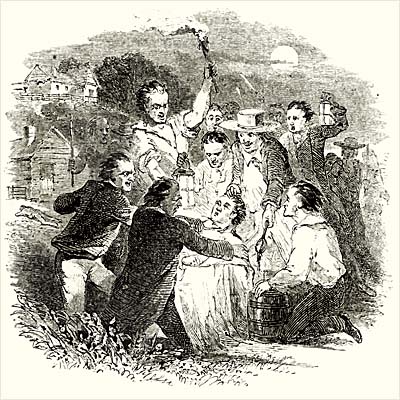
A MOB OF RELIGIOUS COMPETITORS TARRING AND FEATHERING JOSEPH SMITH From a contemporary woodcut was favorably impressed with the location of the future Zion, Joseph Smith returned to Kirtland, Ohio, where he had plenty to occupy him, and left others to build up Zion in Missouri. One of the Prophet's main occupations at this time was a new translation of the Bible, which he was making with the aid of some ancient papyrus. This had come into his possession in a 78 BRIGHAM YOUNG (pages 78-80 not transcribed) THE HOUSE OF BONDAGE 81 (top part of page not transcribed) Healing was practiced regularly, and Joseph Smith's miracles were almost of daily occurence. He exercised moderation in miracles, however, with those who were not yet convinced of his divinity. A Campbellite clergyman visited the Prophet and said, :Mr. Smith, I want to know the truth, and when I am convinced, I will spend all my talents and time in defending and spreading the doctrine of your religion, and will give you to understand that to convince me is equivalent to convincing all my society, amounting to several hundreds." The prospect sounded interesting to the Prophet, and he began to expound the Mormon doctrine. "Oh, this is not the evidence I want," the preacher interrupted, "the evidence I wish to have is a notable miracle; I want to see some powerful manifestation of the power of God... and if you will not perform a miracle of this kind, then I am your worst and bitterest enemy." "Well," asked Joseph, "what will you have done? Will you be struck blind, or dumb? 82 BRIGHAM YOUNG Will you be paralyzed, or will you have one hand withered? Take your choice, choose which you please, and in the name of the Lord Jesus Christ it shall be done." "That is not the kind of miracle I want," the preacher observed. "Then, sir," Joseph said, "I can perform none, I am not going to bring any trouble upon anybody else, sir, to convince you." ... (remainder of text not transcribed) |
|
Transcriber's Comments
|
Back to top of this page
History Vault | Bookshelf | Spalding Library | Mormon Classics | Newspapers
HOME unOFFICIAL JOSEPH SMITH HOME PAGE CHRONOLOGY
last updated: Jan. 6, 2010