
|
Robert B. Neal Anti-Mormon Leaflets (Kentucky, early 1900s) |
 |
1900s Christian Standard | 1897 D. H. Bays book | 1914 C. A. Shook book
|
As Mormon editors and publishers have seen fit, by "revelation," perhaps, to omit the "title-page" and the "preface" of the Palmyra edition, the original edition, from all subsequent editions, there comes a call from polemics for a sworn copy of both to paste in front of their "Books of Mormon" for use in debates. Even the Palmyra reprint, by the Whitmerites, leaves out, for evident reasons, both "title-page" and "preface." With these supplied, a polemic has, for a nominal price, practically the now rare and costly copy of the original Book of Mormon. We have both the original and the reprint before us, and know whereof we affirm. |
|
|
|
"The fact can not be denied that the world (with very few exceptions outside of the Reorganized Church) believes firmly that Brother Joseph received that revelation, or that he taught and practiced polygamy near the close of his life in Nauvoo. Now, on account of honest enquiries as to the truth of the Book of Mormon, it is necessary that I speak upon this matter. I am constantly receiving letters of inquiry as to my belief and knowledge concerning the question of polygamy. I have also another important reason for speaking on this subject: There are false doctrines of importance in the Book of Doctrine and Covenants, and I desire to prove them false doctrines, and get you to lay them aside and believe only what Christ taught and meant for us to believe. This was Christ's mission into the world. It is the mission of all the servants of God; to root out all false doctrine and error. So do not think that I mean to persecute you, or that I am striving for the mastery. |
|
Just now, while the Smoot case is pending before Congress, we should hit swift and hard. Every religious and county weekly should cry out against seating him, on the ground that he is a traitor to our country and a foe to our flag. |
|
Play an important part in the history of the Book of Mormon. |
|
We hand out another sample of "Oliver Cowdery's Defence." |
|
We knew of it early in our anti-Mormon fight. Tried, in vain, for years, to get hold of a copy. At last success crowned our efforts. By paying "a good big price," we secured a copy. Here is a copy of the title page: |
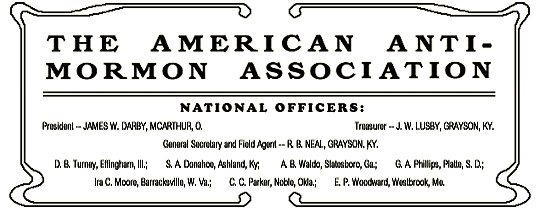
"Sword of Laban" Leaflets, No. 11. R. B. NEAL, GRAYSON, KY. OLIVER COWDERY'S DEFENSE.
[ 2 ]
Note 1: The Rev. Robert B. Neal's supposed excerpt from the so-called "Cowdery Defence" (as provided in the above leaflet), should be read in sequence after his similar excerpt in "Sword of Laban Leaflet" no. 11. Probably the excerpts featured in Leaflets 6, 7 and 11 were initially printed in Neal's Christian Weekly during the second half of 1906. From that original source the purported excerpts were scattered promiscuously through Neal's 1906 leaflets as he published those occasional offprints, resulting in the Leaflet 11 text being published out of proper sequence. Neal published the entire "Defence" as his Anti-Mormon Tracts No. 9, near the end of 1906. |
|
The facts concerning Cowdery's relation to early Mormonism have been presented in preceding leaflets. These facts will season the following too highly to be palatable to Mormon elders. |
|
Judge W. Lang of Tiffin, O., was a law partner of Oliver Cowdery, and claims to have gotten close to Cowdery. His letters may have amarket value in solving some of the Mormon problems. |

|
Mr. J. H. Gilbert, Palmyra, N. Y., was the printer who "set up the type" for the original "Book of Mormon." He also handled the copy, took the proofs, "corrected the galleys," made up the forms and no doubt helped pull the press. |
[Title Unknown] (under construction)
|
[Title Unknown] (under construction) |
[Title Unknown] (under construction) |
JOSEPH SMITH ON CELESTIAL MARRIAGE BY CHARLES A. SHOOK The Reorganized Church of Jesus Christ of Latter-Day Saints makes the assertion that in no sermon, lecture or newspaper article, published during the lifetime of Joseph Smith, can a single statement of his be found in which he endorses the doctrine of a plurality of wives. |
THE AFFIDAVIT OF JOSEPH B. NOBLE BY CHARLES A. SHOOK Joseph Bates Noble was an elder in the original Mormon Church at Nauvoo. He was a good Mormon and "took up his cross and lived his religion." He was also one of the first to perform the plural marriage ceremony for his prophet, Joseph Smith. In the following affidavit, he tells when and where this was done and gives the names of the woman: |
MURDER OF GENERAL JOSPEH SMITH, JUNIOR BY R. B. NEAL We have before us a copy of the Times and Seasons ("Truth Will Prevail" -- City of Nauvoo, Ill., July 15, 1844. Vol. V., No 13, Whole No. 87). It has editorial comments on the killing of "Gen. Joseph Smith" and his brother, Hyrum, at Carthage, Ill., on June 27 1844. The editor says (page 585) that "Gen. Joseph Smith" said, on his way to Carthage: "I AM GOING, LIKE A LAMB, TO THE; SLAUGHTER." Mormon writers from then to now make much of that saying as a prediction that puts a "prophet's feather" in the cap of "Gen. Smith" and a basis for points of comparison between "Gen. Smith's" death and that of Jesus, the 'Man of Galilee," who died on a Roman cross. The editor, on page 585, tells us that Joseph and Hyrum Smith "were Masons in good standing." Also, that they both "gave such signs of distress as would have commanded the interposition and benevolence of savages and pagans." In other words, Gen. Joseph Smith, to escape death, gave "signs of distress, called on Masons" to save him, called in such a way that every Mason who saw or heard him was in obligation bound to risk his life to save Smith. This destroys the lamb-likeness of his death. Jesus could have made "signs of distress" to angels and "legions" would have come to his rescue. Note that military title, "GENERAL" Smith; the word "lamb" cannot be framed from its letters. It is against every attribute of the meek and lowly animal that was made a type of Jesus. Note, also, that General Smith had a pistol -- a six-shooter -- and used it. It is claimed by some that he took a life or two and wounded others before he was killed. He died with vengeance in his heart and perhaps blood on his hands. What a comparison with the gentle Savior and his earnest cry to the Father to forgive his enemies! When this document gets into circulation we opine that the "elders" will cease to contend that General Smith was a true prophet in his last prediction that he would "be led like a lamb to the slaughter." There was nothing lamb-like in his death -- using a pistol, trying to kill all he could, perhaps killing some, and making "signs of distress" to his Masonic friends to save him, no matter how many lives they lost or took in the effort. His death was more like that of a wolf fighting for life than of a lamb meek and submissive to death. Since writing the above, we find in the Deseret Semi-Weekly News, Dec. 25, 1911, the following confirmatory paragraph: "The Prophet turned from the prostrate form of his murdered brother to face death-dealing guns and bravely return the fire of his assailants, 'bringing down his man every time' and compelling the late Secretary of State, John Hay, who, but reluctantly, accords the Prophet any quality of virtue, to confess that he made a handsome fight in the jail." (This is the late Secretary of State, John Hay, in the Atlantic Monthly for December 1869: "Joe Smith died bravely. He stood by the jamb of the door and fired four shots bringing his man down every time. He shot an Irishman named Willis, who was in the affair from his congenial love of a brawl, in the arm; Gallagher, a Southerner from the Mississippi bottom, in the face, Voorhees, a half-grown hobbledehoy from Bear creek, in the shoulder, and another gentleman, whose name I will not mention, as he is prepared to prove an alibi, and besides, stands six feet two in his 'moccasins.' In a later paragraph he refers to the 'handsome fight in the jail.'") A man who can see "lamb-like" qualities in the Prophet's death at Carthage can weave moonbeams into rugs of solid gold. USE SENSE AND SAVE CENTS! The Sword of Laban, R. B. Neal, Editor, $1.00 per yearThe Southern Teacher, J. W. Lusby, Editor, 1.00 per year Our Offer for a limited time is Both Papers One Year for One Dollar THE SWORD OF LABAN has an International reputation as a Mormon Fighter. It will widen its field to Mountain Missions, a work equally as important. THE SOUTHERN TEACHER is a new-comer, but is rapidly rushing to the vanguard of school magazines. While its main field is the Sunny South, it is a National paper, and is going East, North and West as well. There is food in it for both teachers and pupils, parents and children. Send for Sample Copies of both papers. ==> Send 10 cents for a copy of "The Mountain Meadow Massacre." ==> Send 10 cents for a copy of "Oliver Cowdery's Defence and Renunciation." ==> Send 25 cents for a copy of "Whitmer's Address To All Believers," ==> Send 50 cents for a copy of "Book of Commandments." The above will be found handy for all who wish to confute Mormonism. Subscribe for The Sword of Laban A monthly sanctified wholly to the suppression of Mormonism. The only paper in the world devoted to battling the ism. $1 per year. Address R. B. NEAL, Editor, Grayson, Ky.Sword of Laban Hand-Book for Anti-Mormon Polemics. This work is in preparation by R. B. Neal, Grayson. Ky. The advance price will be $1. Send no money now. Send name on postal, saying, "I will pay one dollar cash on delivery of the Hand-Book for Anti-Mormon Polemics." This will enable the publishers to know how many copies to issue. Don't delay. DO IT NOW.Note: Although this leaflet does not bear a date of issue, it must have appeared after the Dec. 25, 1911 newspaper referred to in the text. Rev. Neal must have published this, apparently his penultimate number in his second series, early in 1912. |
Did Joseph Smith Walk on Water? BY R. B. NEAL. The Mormons are, on this issue, like they are on every other, inconsistent. They have both affirmed and denied it. |
|
Transcriber's Comments
|
Back to top of this page
History Vault | Bookshelf | Spalding Library | Mormon Classics | Newspapers
HOME unOFFICIAL JOSEPH SMITH HOME PAGE CHRONOLOGY
last updated: May 15, 2011