
|
Jonathan B. Turner (1805-1899) Mormonism in all Ages (NYC: Platt & Peters, 1842) Chap. 1-3 | Chap. 4-6 | Chap. 7-8 |
 |
1842 J. K. Noble Letter | Turner Reading Room | Turner Slide Show
|
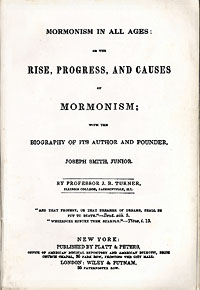
MORMONISM IN ALL AGES: OR THE RISE, PROGRESS, AND CAUSES OF M O R M O N I S M; WITH THE BIOGRAPHY OF ITS AUTHOR AND FOUNDER, JOSEPH SMITH, JUNIOR. B Y P R O F E S S O R J. B. T U R N E R, ILLINOIS COLLEGE, JACKSONVILLE, ILL. "AND THAT PROPHET, OR THAT DREAMER OF DREAMS, SHALL BE PUT TO DEATH." -- Deut. xiii. 5. "WHEREFORE REBUKE THEM SHARPLY." -- Titus, i, 13. NEW YORK: PUBLISHED BY PLATT 7 PETERS, OFFICE OF AMERICAN BIBLICAL REPOSITORY, AND AMERICAN ECLECTIC, BRICK CHURCH CHAPEL, 36 PARK ROW, FRONTING THE CITY HALL. LONDON: WILEY & PUTNAM, 35 PATERNOSTER ROW. |
[ 9 ]
CHAPTER II.
10 C O N T E N T S.
CHAPTER III.
CHAPTER IV.
C O N T E N T S. 11
CHAPTER V.
CHAPTER VI.
CHAPTER VII.
12 C O N T E N T S.
CHAPTER VIII.
|
|
INSTINCT OF FAITH
65
HAVING considered the rise and progress of Mormonism, we pause for a moment to compare it with similar delusions. Much of the history of our race, in respect to religion, is the history of fanaticism. Amid so vast an amphitheater of religious lunatics, we shall find some more eccentric, if not more insane, than others; and by casting our eyes back upon the scene, and reflecting upon the credulity and weaknesses of the race, we shall be better prepared to appreciate this new development of human folly, and to contemplate its absurdities without either amazement or alarm. There are three fundamental principles which sway the destinies of the human race. 1. The religious element in the nature of man, which I shall call the instinct of faith. 2. The instinct of independence. Pages 66 to 87 not yet transcribed. 88 PARTICULAR FANATICISMS. that they were the two last witnesses spoken of in Revelations. They denounced the "ministry of the churches as a lie and an abomination unto the Lord," declared that they were great prophets, had power to work miracles, absolve sins, &c., &c. The terrible persecutions which attended the revocation of the edict of Nantes, in 1685, were accompanied with another shoal of fanaticisms on the continent of Europe. Three years after, in 1688, the Camisards, or French prophets, appeared. In Dauphiny and Vivarais, in France, five or six hundred of both sexes gave out that they were prophets, inspired of the Holy Ghost. Their number soon increased to thousands, and though of all ages and sexes, they were mostly boys and girls from fifteen to twenty-five years of age. They had strange fits of trembling, fainting, and swooning. They fell on their backs, shut their eyes, saw heaven opened, the angels, paradise, and hell. They dropped down thus, not only in popular assemblies among thousands, but also in the fields alone they fell, and made the hills resound again with their cries for mercy, imprecations on the prevailing sects, and predictions of the near approach of the day of millennium glory. Then, New Jerusalem, the marriage of the Lamb, the reign of the Messiah, and acceptable year of the Lord, was of course to be ushered in by a deluge of judgments: -- sword, fire, famines, earthquakes, plagues, and wars, were all piously reserved for the benefit of their enemies; while the one faith, one baptism, one Lord, and one eternal reign of Mormon glory, was to be their own peculiar inheritance. They pretended not only to the gift of prophecy, but also to the gift of tongues, of miracles, PARTICULAR FANATICISMS. 89 and of healing, of discerning spirits and the secrets of the heart, and to the Mormon power of conferring all these by the laying on of hands. They were brought to the fullest conviction of the reality and truth of all their pretensions, by the internal voice of the Spirit of God, communicating delight and holy joy to the soul, and pouring forth upon them a wonderful fervor of assurance and spirit of prayer. All they said was heard with the utmost reverence and awe. They spread like wildfire, not only on the continent of Europe, but in England. They there gave out that one of their teachers, who had died, would come to life again; fortunately he did not appear, though the multitude kept on believing. In 1685, the Tremblers of Cevennes appeared, and were soon followed by the Convulsionaries of St. Menard, both of which sects will be noticed in another place, for a different purpose from the one now on hand. In 1686, Sir Walter Scott informs us that the good people of Lanark, in Scotland, saw showers of spiritual swords, guns, hats, bonnets, caps, &c., fall for days in succession. About this same period, also, Sabbatai Levi appeared in the east, and the Quietists in France and Spain, already alluded to. Valentine Greatrakes, who appeared in Ireland, and Emanuel Swedenborg, of Sweden, were also among the progeny of this wonderful period of combined persecution, credulity, and delusions. Swedenborg, a son of the bishop of Gothnia, was born in Stockholm, Sweden, in 1688. He was a man of genius, enthusiasm, and extensive learning, and ultimately founded the New Jerusalem Church, which bears his name. His hegira occurred in 1743. At that 90 PARTICULAR FANATICISMS. time, also, the Lord manifested himself to him, as he imagined, by personal appearance; and opened his spiritual eyes, as he had done the eyes of thousands, both before and since. He, however, was peculiarly favored, for he was enabled to see and converse with spirits, uninterruptedly, for more: than twenty-seven years. Thousands, in all parts of christendom, have believed in the revelations which he published. He maintained that all others might enjoy this same gift of second sight, if they would live in accordance with what he called the laws of their spiritual nature, as doubtless many of them might, and indeed all who could first get a spiritual nature, like his own. Multitudes of day-dreamers, in as many various churches, might attest the truth of this. Unlike most other enthusiasts, however, he was probably sincere in his delusion; and, whatever may be said of the whimsical absurdity of his conceits, his writings, doctrines, and life, were neither vulgar nor immoral, as is the case with most other marvel-dealers. He was probably a learned, pious, devout monomaniac; a little more eccentric, though scarcely more absurd, or insane, than thousands of others whom the world call wise and devout. The famous witchcraft phrensy, which exploded in Salem, New England, in 1692, belongs to this same period. Previous to this time, all classes believed in witchcraft, both in this country and in Europe. It was deemed the highest impiety to doubt it, and supposed witches were treated as capital offenders throughout christendom. Divines, statesmen, jurists, physicians, philosophers, and scholars, were all alike swept into this vortex of fanatical delusion, the combined offspring of that infernal spiritual despotism and contemptible credulity, PARTICULAR FANATICISMS. 91 which had for ages crushed and enfeebled the human race. So direful was this mania, that when the British parliament repealed the laws for the execution of witches, in 1735, Scotchmen, of the kirk, confessed and deplored that act of benevolence and humanity as among the annual category of their national sins. In New England, the learned and pious Cotton Mather, by a mistaken zeal, harangued and inflamed the already exorbitant credulity of his hearers. He taught them that they were, one and all, attended by an escort of devils, at home or abroad, awake or asleep, from whose malignant power they could not escape; and to cap the climax of absurdity, he declared that the detestable proceedings of the court at Salem, he thought, had shed marvelous light upon the Word of God!! Of course, these devils soon furnished the people with business. Not only decrepit old men, and helpless women and children, but even dogs were solemnly adjudged and executed, for the imaginary crime of witchcraft. This example is not quoted as an instance of religious fanaticism, properly speaking, but rather to show that there is no end to human credulity, when guided by a popular and fanatical corps of spiritual instructors. Some have imagined that the devil was indeed let loose in a peculiar manner, at this period. No doubt he was; but it was to befool fanatics and courts, not to bewitch dogs. Doubtless, also, the impending horror of Indian wars, and the general consternation of the times, both aided the credulity of the age and prospered the devil in his work.* In 1728, soon after the rebellion in Scotland, John Glass arose in that country, founded the sect of Glassites, ____________ * See Upham's Witchcraft, pages 256, 268. 92 PARTICULAR FANATICISMS. and taught, among other dogmas, the Mormon doctrines of weekly administration of the Lord's supper, washing each other's feet; literal interpretation of the Scriptures, and community of goods; so far as needed for the poor and the service of the church. Another general crop of fanatical sects sprung up, in Great Britain and America, after the great revivals of Whitfield, Wesley, Edwards, and others, and which seem, in some measure, to have clustered around the American and French revolutions. In this class come the Jumpers of Wales, already mentioned, and Jemmia Wilkinson, Ann Lee, Mrs. Buchan, of Scotland and Joanna Southcote, of England. In 1776, Ann Lee, daughter of a blacksmith in Manchester, England, commenced her operations near Albany, New York. She was subject to peculiar spasms and convulsions, as many other impostors have been. In these fits, she would clench her hands until the blood oozed through the pores of her skin. She sometimes continued in them until her flesh and strength all wasted away, and she was fed and nursed like an infant. She had supernatural visions and revelations. Like the wife of Smith, she pretended that she was the elect lady, and also that she was the woman spoken of in Revelations; that she and Christ were the two first pillars of the church, and that no blessing could descend to any person but through her. She declared that she was the mother of all the elect, and travailed in childbirth for the whole world; that she could converse with the dead, and speak seventy-two different languages; that she should never die, but ascend to heaven in the twinkling of an eye. She did die, however; but her death was so far from opening the eyes of her dupes, that it PARTICULAR FANATICISMS. 93 rather confirmed them in the faith, and she still numbers about five thousand followers in the United States. Like the Mormons, they believe that they are the only true church on earth, that they shall reign with Christ a thousand years, that they have all the apostolic gifts, and like them, they prove all their doctrines from prophecy, as well as by signs and wonders. In the same year, 1776, Jemima Wilkinson, the daughter of a Quaker, of Cumberland, Rhode Island, gave out that she had been taken sick, and had actually died, and that her soul went to heaven, and continued there. She heard the inquiry in heaven: "Who will go and preach to a dying world? She answered, "Here am I, send me." Her body was then re-animated by the spirit of Christ, upon which she set up as a public teacher, to give the last call of mercy to the human race. She declared that she had arrived to a state of perfection, and knew all things by immediate revelation, that she could foretell future events, heal all diseases, and discern the secrets of the heart. And, if any person was not healed by her, she attributed it, as the Mormons do, to a want of faith. She assumed the title of universal friend; declared that she had left the realms of glory for the good of mankind, and that all who would not believe in her should be damned. Her first visions occurred during her pretended illness and death, when twenty-four years of age, in 1775. After this, she enjoyed them at her leisure. She pretended that she should live a thousand years, and then be translated, without death. She preached in defence of a community of goods, and took, herself, whatever "the Lord had need of." Multitudes of the poor, and many of the rich, believed on her in New England, and made large 94 PARTICULAR FANATICISMS. contributions to her. Some gave hundreds, and one even a thousand dollars for her use. Several wealthy families were ruined by her. Neither theft, nor attempted murder, nor the hypocrisy of failing to walk on water, and of attempting to raise a living man to life, placed in a coffin for that purpose, in all which she was fully detected, could undeceive her followers. In spite of her pretended immortality, she died in 1819. Her followers would not believe in her death, even when they saw her corpse. They refused to bury her body, but at last, were compelled to dispose of it, in some way, in secret. Those most interested in the game, by the double magic of either loss or gain, pretended that she had only left them for a time, to return again, and that her spirit would still be the guardian angel of all her followers, who of course, kept on believing. * In 1783, a Mrs. Buchan, in Glasgow, pretended that she also was the woman spoken of in Revelations; that the end of the world was near, and that all who believed on her should be taken up to heaven without tasting death. Her own death, however, in this case did somewhat stagger the faith of her followers. In 1792, Joanna Southcote, a servant maid of Exter, England, assumed the character of a prophetess, and pretended that she was the woman of the wilderness, and could give the seal of eternal life to her followers. Like Smith & Co., she uttered dreadful prophetic denunciations upon her opposers and the unbelieving nations, and predicted the speedy approach of her millennium. Of course her thousands of followers found all her predictions fulfilled. In the last year of __________ * Millennial Harbinger, vol. II., page 278. PARTICULAR FANATICISMS. 95 her life she secluded herself from the world, and especially from the society of the other sex, and gave out that she was with child of the Holy Ghost, and that she should give birth to the Shiloh promised to Jacob before the end of his harvest, which would be the second coming of Christ. Harvest, however, came and went, but no Shiloh appeared. She died on the 27th of the following December. Her disciples refused to buty her. They waited four days for her resurrection and the birth of the Shiloh, until she began to rot. They then consented, with much reluctance, to a post-mortem examination, which fully refuted their belief. Her disciples then, with still greater reluctance, buried her body, but not their faith in her or the promised Shiloh. On the contrary, they continue to flatter themselves that she will yet, in some way, reappear, and that with her will come their long expected Shiloh, and their Mormon gathering and millenium of Mormon glory. In this same year, 1792, Richard Brothers published a book of prophecies and visions, and an account of his daily intercourse with God, in London. Among his followers was a member of the British parliament, a profound scholar, and one of the most learned men of his time. He made a speech in the house of commons declaring his full belief in one of the greatest absurdities ever presented to the British populace. In the crop of religious fanatics we must also mention the Illuminati, or French atheists, whose particular fanaticism, owing to the peculiarity of the age and country in which they lived, took the form of extreme and puerile credulity in unbelief. That is, they refused to admit and believe the religion of truth and reason 96 PARTICULAR FANATICISMS. which God has given to the world, and set themselves to work, as all other fanatics have done, to make a better one for themselves and their race. Other fanatics have disbelieved and denounced what they called the absurdities of a particular faith, and advanced and pretended to believe still greater absurdities of their own. The infidel fanatics of France, on the contrary, denounced the absurdity, or what they deemed such, of all faith, and advanced an absurdity of their own which implies and demands a greater stretch of human credulity than the combined sense and nonsense of all other creeds. Men may prattle about unbelief, but, after all, they believe something, and that something which infidels and skeptics do actually believe, be it more or less, will be found, on examination, to be more absurd than the combined dogmas of all other fanatics. Atheism is necessary the greatest of all credulity. It is the same perversion of a man's religious nature which constitutes the basis of all other fanaticisms. Disbelief of what is rational, is real or pretended belief in what is absurd. The greatest fanaticism of any age is the fanaticism of the atheist. Probably most of the impostors of other names have themselves been at heart athiests, or at least skeptics. Other fanaticisms are more or less selfish and malignant. The fanaticism of atheism is, inherently, all selfishness and all malice. Other fanatics attempt to relieve a portion of mankind of their instinctive fear of a final retribution, by inculcating the belief of some particular absurdity. The fanatical atheist attempts to relieve at once the whole human race from the same salutary fear by inculcating belief in dogmas which render the globe a riddle, and man the greatest of all PARTICULAR FANATICISMS. 97 absurdities in and of himself. To relieve their followers from fear, other fanatics sometimes reason absurdly; but the atheist does the business at once, by making all reason, and the universe itself a riddle and an absurdity. In France, however, they compromised the matter somewhat, at last, and after proclaiming that there was no God, no virtue, no crime, no heaven, and no hell, they established the worship of the goddess of reason, to satisfy the unquenchable instincts of the human soul, insread of the worship of Joanna Southcote, or Jemima Wilkinson, or Joe Smith, as other fanatics have done. The result of this experiment, and the number of their dupes in this country and Europe, are too well known to need further comment here. These are all the religious fanaticisms of note which clustered around the political revolutions of the last part of the past century, unless we include the fanaticism of what is called the Kentucky revival, in the year 1800, which will be advertised to in another place. After these tumults, the world again had some rest, until about the year 1830, when another crop of fanaticisms seems, from some cause, to have been produced, particularly in the United States. In this shoal we find Miss Campbell, of Scotland. Irving and Mad Thom, of England, Dilks, of Ohio, Davison and Mrs. Thompson, of Vermont, Matthias and Joe Smith, of New-York. Miss Campbell appeared, in good old Scotland, about the year 1828. She pretended that she had come back from the dead, and had the gift of tongues. Several ministers of the church of Scotland are said to have believed on her, as well as some distinguished members of the bar. The mad rhapsodies of Irving 98 PARTICULAR FANATICISMS. are too well known to need further notice. The particular history of Mad Thom is not at hand; that of Matthias has recently appeared in most of the journals of the day. Like him, Dilks, the impostor of Ohio, pretended to be Almighty God himself. Davidson, his disciple, appeared in the vicinity of Bakersfield, in Vermont, in 1829. He pretended that Jesus Christ was a woman, and inferior to Dilks, who was God himself. A female, by the name of Thompson, accordingly appeared as Jesus Christ, the son of Dilks. The millennium was to take place in 1832. Dilks and his followers were to assemble at Philadelphia, as their Mount Zion, where they were to reign forever, while the rest of mankind were to be swept from the earth. They made preparations, as Jemima Wilkinson had done before them, to raise the dead; but the woman selected for the purpose got tired of lying in the coffin and came forth of her own accord, before they were ready to pray her into life. They got about thirty disciples in the vicinity of Bakersfield, where they assembled on the Sabbath, and rolled nacked on the floor, men and women together, as part of their worship, and committed other sins too revolting to mention. Still they found plenty of followers. * Another fanatic appeared in Connecticut, about the year 1833, who pretended that he was Jesus Christ, and, in a public meeting in _______, professed to show the prints of the nails of his crucifixion in his hands. The people, finding that he was working upon the credulity of the simple, wrongfully imprinted more needful and obvious marks upon his back, and he suddenly __________ * See Burlington Sentinel, June, 1831, and Millenial Harbinger, Vol II, page 357. GENERAL IGNORANCE OF FACTS. 99 disappeared, as Davidson and his followers did on the application of tar and feathers in Vermont. We must protest, hiwever, against these things, even in the most extreme cases. Instruct the people and not abuse fanatics. That is the way to kill fanaticism and rid the world of impostors. The history of Smith, who marches triumphantly in the front of this last escort of fanatics, has been already given. I have been thus tedious and particular in giving a brief summary of all the recorded fanaticisms of these later times, because a simple statement of facts will tend to wither up that lamentable credulity of the human mind, which lies at once at the foundation both of all fanaticism and all infidelity, more effectually than all the logic and argument in the universe. "Let but the people know these things," and they would act with more enchanting power upon their minds than the will of Caesar could upon the Romans. The people generally have homilies, doctrines, and dogmas enough ever at hand; but they are starved for want of facts. The well-informed, because they themselves know all these and similar facts, are too apt to take it for granted that everybody else knows them too; and that some bare allusion to them will awaken the same ideas in other minds which it does in their own. This is a great mistake, and one which we have endeavored to remedy, not for the benefit of those who have been tolerably instructed in matters of faith, but for the good of the ignorant and uninformed. Others may pass this tedious and disgusting detail, or read and pardon it, as they choose. In view of these facts, however, some few remarks 100 REFLECTIONS ON FANATICISMS. will perhaps be useful to all: at least they will cinduce more directly to the specific end in view. 1. During the dark ages, amid the total dereliction of all reason in matters of faith, and the consequent persecutions, massacres, famines, and plagues that at once ravaged and terrified the globe, the prime causes of the most eccentric human credulity and fanaticisms, ignorance and terror, were ever present and ever active. By examining the dates, it will be perceived that the most hideous fanaticisms, since that period, have all either clustered about similar epoches of general terror, or have followed, as a sort of after-clap, some more dignified, if not more rational outbreak of religious enthusiasm. 1. The first was the German crop, of about the year 1530, which attended the agitation and turmoil of the Reformation. It embraces the various adherents of the Anabaptists and followers of David George. 2. Next came the English crop of Quakers, Seekers, Muggeltonians, &c., about 1650, in the days of the English Revolution. 3. Then came the great French crop, during the terrible persecutions that attended the revocation of the edict of Nantes, and the horrid hangings, starvings, smokings, drownings, and roastings of that infernal era, including the French Prophets, the Quietists, and Tremblers of Cevennes, followed by the Convulsions of St. Menard. 4. The English-American crop, escorted by the French infidels, appeared at the close of the last century, during the French and American revolutions, and immediately after the great revivals in this country CROPS OF FANATICS. 101 and in England. It embraces the Jumpers, in Wales, the Buchanites of Scotland, and the followers of Ann Lee, Jemima Wilkinson, and Joanna Southcote, and, if you please, the Kentucky Revivalists. The crop on hand, viz., Miss Campbell, Mr. Irving, Mad Thom, Mrs. Thompson, Dilks, Matthias, Joe Smith, Abner Kneeland, Fanny Wright, &c., were produced neither by famine, war, nor terror, but by folly. It would seem, in this case, as if all antecedent causes were reversed, and that now, in an age of profound peace and universal ease and plenty, men turned maniacs, and ran after fools from sheer ennui, because they had nothing else to do. The Illuminati of France and Spain, and Antoinette Bourignon, appeared immediately after the Massacre of St. Bartholomews, in 1572. Sabbati Levi appeared in 1666, immediately after the terrible massacre of the Jews in Persia. The Glassites, in Scotland, arose soon after the Scotch rebellion in 1715. The Salem witchcraft followed the terrors of the dreadful Indian war and other calamities. These are the most noted instances of human credulity, in respect to religion, since the revival of letters, except Emanuel Swedenborg, and a few similar cases, which stand either sacred or sui generis. I have merely located these events; others may philosophize upon them as they choose. So will I. It is sufficient for my present purpose to remark, what must be apparant to all, that both persecution and terror, of all sorts, tend to increase the general credulity and fanaticism of mankind. Where these are wanting, an enthusiasic 102 GENERAL AGREEMENT OF FANATICS.
This page not yet transcribed.
GENERAL RELIGIOUS LUNACY. 103
This page not yet transcribed.
104 HUMAN CREDULITY.
This page not yet transcribed.
THE BOTTLE CONJURER. 105
This page not yet transcribed.
106 LOVE OF EXCITING MARVELS.
This page not yet transcribed.
RULES FOR FANATICS. 107
This page not yet transcribed.
108 GROUND OF HOPE.
This page not yet transcribed.
GROUND OF HOPE. 109 single arm for a single age. It is pleasant to reflect that even the absurdities of Mormonism are in many ways, though unwittingly, hastening on this great day of the final triumph of truth. Even here, it may be noticed with gratitude, that the Lord is bringing good out of evil.
Continue reading on: |
|
TRANSCRIBER'S COMMENTS
Jonathan Baldwin Turner, a pioneer of agricultural education in Illinois and the United States, epitomized the spirit and intent of the scholarships bearing his name. A noted farmer and lecturer associated with Illinois College during the mid-1800s, Turner envisioned a nationwide system of educational institutions providing a "liberal and practical education" for citizens in the areas of agriculture and the mechanical arts. Turner's dedication and leadership were influential in the passage of the Morrill Act, signed by President Lincoln in 1862. This law established a framework for the land-grant system of agricultural institutions throughout the United States. A further outgrowth of Turner's efforts was the Illinois Industrial University, later to become the internationally recognized University of Illinois. The above information was gleaned from these web-documents: (1) Jonathan Baldwin Turner Slide Show, (2) Jonathan Baldwin Turner Reading Room, and (3) J. B. Turner scholarships. Turner's 1842 Book on Mormonism Living as he did, relatively close to Nauvoo, at the same time Joseph Smith had his headquarters in that place, Professor Jonathan B. Turner of Illinois College in Jacksonville, had a unique opportunity to research and report the "rise, progress, and causes of Mormonism," as he promises on the title page of his 1842 book. Along with Henry Caswall's books on the Mormons (published the following year) Turner's Mormonism in all Ages was practically the first scholarly reporting ever offered on the advent and rise of the Latter Day Saints. As the title suggests, it was Turner's conclusion that Mormonism was a reemergence of the same kind of periodic religious fanaticism that had given the Christian world the likes of "prophets" Richard Brothers and Joanna Southcote in the previous generation. Turner also makes a brief reference the "Glassites," Christian primitivists and the reformer precursors to Thomas and Alexander Campbell (the one time mentors of Sidney Rigdon): "In 1728, soon after the rebellion in Scotland, John Glass arose in that country, founded the sect of Glassites, and taught, among other dogmas, the Mormon doctrines of weekly administration of the Lord's supper, washing each other's feet; literal interpretation of the Scriptures, and community of goods; so far as needed for the poor and the service of the church. Turner does not follow through with any detailed explanation of how Glassite religious "restorationism" might have been transmitted to the earliest Mormons, however.Although the author makes some attempt to document his source material, his sparse use of footnotes makes it difficult for the modern reader to discern from whence he derived many of his special assertions and conclusions regarding the Mormons and their top leaders. No doubt Turner took most of his material from early newspaper accounts, as well as from word-of-mouth sources available to him in Illinois. The Mormon/anti-Mormon tensions of mid 1842 were just beginning to be reported in the Illinois popular press when Turner released his book. Had he waited another couple of months, he might have incorporated some of the information then being disclosed by the former Mormon chieftain, John C. Bennett and the deponents Bennett solicited in publicizing the secret polygamy at Nauvoo, along with related matters embarrassing to the Latter Day Saints. Turner was no more sympathetic to the Illinois Mormons than was Bennett, but Turner's measured prose might have summarized Bennett's inflamatory (often wildly inflamatory) announcements in a more trustworthy manner. Turner's book was announced as forthcoming as early as 1841 (in the Oct. 16, 1841 Illinoian) and was greeted upon its June 1842 publication by the editor of the New York Journal of Commerce. Turner's book was occasionally mentioned in the newspapers of his day (see the July 9, 1842 Alton Telegraph and the Peoples' Miscellany of Aug. 3, 1842), but no critical review of the volume is known -- and no relevant comments from Turner himself can be found in the pages of those early papers. It appears that John C. Bennett's highly touted 1842 volume simply rendered the previous work of Turner obsolete in the minds of most contemporary readers. Probably Turner's greatest contribution to reconstructing the history of Mormonism is that he wrote a very readable book on the topic which caught the attention of subsequent authors, and which reproduced important material gleaned from earlier obscure sources, such as Eber D. Howe's 1834 book. The Roles of Smith and Rigdon in Mormon Origins Like most of the writers on Mormonism during that time, Professor Turner accepted and broadcast the idea that Sidney Rigdon was at least partly the originator of Mormonism. Turner was a bit more cautious than some writers of his day in pinning "the blame" for Mormon origins on the secretive Rigdon -- perhaps because the conclusive evidence was lacking -- but, in the end, he concluded that Sidney Rigdon and Parley P. Pratt had a hand in bringing the new religion into the world. Notwithstanding the weight of this portentous factor, Professor Turner was reluctant to credit the authorship of the Book of Mormon to Sidney Rigdon's reported revamping of Spalding's historical fiction.Turner lived close enough to Rigdon in Illinois during the early 1840s to form a personal estimation of the Mormon leader, and, in his own words, said he could not "imagine that a man of Rigdon's talent, power of language, and knowledge of the Bible, ever could have jumbled together such a bundle of absurdities as the Book of Mormon is." According to Turner, "Whoever got the Spaulding manuscript, Joe Smith, and Joe alone, is sole "author and proprietor" of its offspring, the Book of Mormon. There is not, probably, another man on the globe that could write such a book, except Joe Smith; and he would not have done it, had not some materials been furnished to his hand to suggest the outline of his story." Having summarily eliminated the Rev. Sidney Rigdon from the role of Book of Mormon writer, Professor Turner nevertheless allowed him a possible place in the clandestine founding of Mormonism. He says: "Whether Rigdon helped him [Smith] to the manuscript, or aided him in the work, we cannot tell. It is certain that, from 1822, he was out of business, and professed to be in Pittsburg studying the Scriptures for three years, while Smith was away from home, no one knows precisely where, except that a part of the time he was in Harmony, East Pennsylvania. During the three years in which Smith was translating his bible, it is also certain that Rigdon was as actively engaged as he could be in building up a church for him in Ohio; whether by intrigue or accident, we will not pretend to say." J. B. Turner's Version of the Spalding Claims Like the other writers of his time who studied Mormonism, Professor J. B. Turner (pp. 206-210) takes up the matter of the Solomon Spalding claims for Book of Mormon authorship. Already, in earlier pages of his volume, Turner had expressed his conviction that Sidney Rigdon was the real founder of the Mormon doctrinal system, and that Rigdon, in fact, been preparing his flock in Ohio for the advent of Mormonism since 1827. However, as previously mentioned, even given his well stated reasons for believing that Rigdon was working behind the scenes with Smith, prior to 1830, Turner fails to make any firm connection between Rigdon and the text of the Book of Mormon. Instead, Professor Turner chose to deduce his own version of the Spalding claims, from a selective examination of the "evidence" at hand.In his book (p. 210), Turner summarizes the story of Solomon Spalding by saying: "Mr. Spaulding wrote a manuscript, while living in Ohio, in the years 1810, '11, and '12, which he called the "Manuscript Found." It was an historical romance of the first settlers of America, endeavoring to show that the American Indians are the lost tribes, the descendants of the Jews..." Turner gives no source for this information. Perhaps he derived it directly from his reading of Eber D. Howe's Mormonism Unvailed, since he elsewhere quotes directly out of Howe to elucidate the Spalding claims. There is a second possibility here, however. It is entirely possible that J. B. Turner solicited information either directly or indirectly from Spalding's widow, Mrs. Matilda Davison, who was still living in Massachusetts at the time Turner was writing his book. Turner could have supplemented the few bits and pieces of the widow's reported testimony given in Howe's book by consulting Matilda Davison's statement as published (in April 1839) in the Boston Recorder. Turner may have also obtained some of his information and ideas directly from Spalding's widow. An undated fragment of the widow's testimony, (published in 1851) reads as follows: In 1817, the year subsequent to my husband's death, I removed to Onondaga county, in New-York, and from thence to Hartwick, Otsego county, in the same State, having with me a trunk containing his writings. At the latter place I married again; and soon after went to Massachusetts. From 1817 to 1820 the trunk remained at Onondaga Hollow. After my marriage in 1820, it was removed to Hartwick, where it remained until 1832. A man of the name of Smith was, between 1823 and 1827, frequently seen prowling round the house without any ostensible object, so suspicious were his maneuvers, that he was once or twice arrested as a common vagabond, and only escaped the penalties of the law by running away. Compare the vert similar content (underlined here for reading ease) of the Widow's reported recollections in the above excerpt -- as published in 1851 -- with Turner's own speculation and deductive analysis below -- as published in 1842: During a part of the time, from 1817 to 1820, she [the Widow] left the said trunk at her brother's house, Mr. Harvey [sic] Sabine, at Onondaga Hollow, not very far from the Smiths, as may be seen on the map. After her marriage, in 1820, the trunk was taken to Hartwick, where she left it, in 1832, with Mr. Jerome Clark. Hartwick is not far from the residence of the famous Stowell, in whose employ Smith dug for money, as he says, in l823. To this place also he was passing and repassing, for four years afterwards, as we have seen, without ostensible object of business, except, as it, appears from the testimony of the people of Bainbridge, he was once or twice arrested as a common vagabond, and finally ran away, to escape the sentence of the law. The trunk and manuscripts were, then, in this vicinity from 1820 to 1832, and of course during the four years of Smith's life, on which he is so silent, as it regards himself. He was, in reality, loitering about these regions, as we learn from other sources. Although it is maginally possible that the 1851 text is an abridgement of Turner's account, it seems more likely that the reverse is true: that is, Turner either expanded his own account from an unknown, pre-1842, printing of the text, or from information supplied him by the Widow herself. Assuming that Turner's account is his expansion upon an earlier text from the Widow herself, it can be seen that Turner has here converted the generic "man of the name of Smith" into one special Smith: Joseph Smith, Jr. Turner deduces that Joseph Smith, Jr. was the person who stole away nearly all of the Solomon Spalding documents from the Widow's "trunk full of manuscripts" in Otsego Co., New York. Here is Turner's rationalization for this rather bizzare assertion: ... who took them [Spalding's manuscripts] all away but one? Why was Smith prowling about there for four years? During that time, both he and his family were telling strange stories about a book or manuscript that, was to be found, as we shall see in the sequel. Why did he go to Harmony, Penn., to translate his book? If he really succeeded in getting the manuscript from Mrs. Spaulding's trunk, or if some one did it for him, this accounts for its disappearance, and for all other known facts in the case. That all the writings are missing, and cannot be found, with the exception of this one small romance of the later origin, is a known fact. That Mr. Spaulding wrote another and larger edition of the work, similar in all its leading features to the "more history parts" of the inspired translation of the Book of Mormon, is also certain. That it might have been taken from Pittsburg is possible; but that it was taken from the trunk in Otsego county, and finally fell into the hands of Smith, while in connection with Stowell, is far more probable. That it is gone, and that Smith had both seen and read it before his prophetic mission, is as certain as it is that the Book of Mormon exists. Although Turner's conclusion is an ingenious one, it is almost certainly wrong. There is substantial testimony to demonstrate that the particular Spalding manuscript which allegedly resembled the Book of Mormon was safely stored away at the Jerome Clark home in Hartwick, New York until after the latter book was published in 1830. It seems quite unlikely that the then very young Joseph Smith, Jr. would have stumbled upon Spalding's writings either while they were in Onondaga Hollow or at Hartwick. And, even if he did know of such literary artifacts, he appears to have no motive or opportunity to have absconded with them. Whatever the historical facts may have been, the publication of Professor Turner's book in 1842 marked the first notable popularization of the notion that the young Joseph Smith had purloined the writings of Solomon Spalding. This sub-theory of the Spalding authorship claims survived down into the late 20th century and was given credence by Vernal Holley in his 1983 book, Book of Mormon Authorship. Reproduced below is a map from the 1989 edition of Holley's book, in which he, like Turner before him, attempts to show the proximity of Smith's whereabouts during the 1820s and the village of Hartwick, in western New York: |
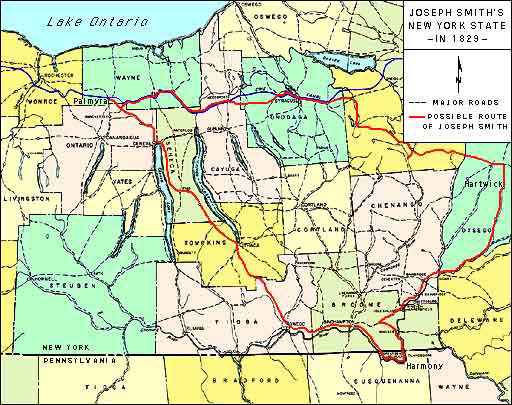
Vernal Holley's 1983 Map
|
Joel King Noble's 1842 Letter
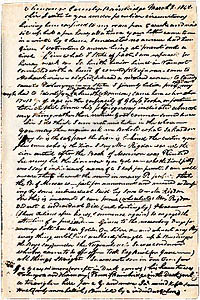
When Jonathan B. Turner was researching his book on Mormonism he sent out letters to various early witnesses of the phenomenon, soliciting their input. One of the responses he received came from Judge Joel King Noble, a prominent early citizen of Bainbridge, Chenango Co., New York. Unfortnately Judge Noble's letter arrived too late for Turner to include the information it contained into the first (and only) edition of his 1842 book. Had Turner received this letter earlier, he might have excluded the name of Sidney Rigdon altogether from his discussion of Mormon origins. At least Judge Noble claims to have firsthand knowledge of who compiled the Book of Mormon and he does not include Rigdon's name on his short list of two originators (or initial promoters) of Mormonism. On page 1 of his letter Noble says: ...You may then enquire ask me Behold what Jo. has Don[e]It is impossible to know how seriously to take Noble's profession in this letter. Numerous investigators of Smith's early years have come away from their study of this enigmatic individual with the impression that he did not act entirely on his own in founding the Mormon religion. Some students of the man even postulate that he was the kind of "cats paw" Noble speak of in his letter -- that Smith moved from ritual magic and treasure-locating to claims for a "new revelation" via the direction and help of individual(s) "behind the curtain," as Judge Noble puts it. The context in which Noble places his allegation appears to remove the names of Parley P. Pratt and Oliver Cowdery from the list of possible "lions" behind that secret curtain, as they were well known early Mormons and occasionally guessed to be Smith's secret accomplices at the birth of the new sect. Had these been the names Noble had in mind, he might have divulged them or hinted at them, but he does not. More likely Noble had two other names he was holding back from Turner "for present." There is no indication any where that Noble ever communicated these names, however. Judge Noble's claim to firsthand knowledge in this case, his elimination of Rigdon as the original "lion behind the curtain," and his reluctance to disclose the identity of that "lion," are all points reminiscent of the early testimony of another contemporary of Joseph Smith. Jr. in New York. This second deponent was William Buell Fairchild, a near neighbor of the Smith family in Ontario County when young Joseph was growing up there. In an 1845 account, Fairchild says: "Let us first notice the 'Golden Bible'... No one, at that time, who knew Joe Smith, had the most distant idea that he was the author, or was in any way connected with the 'getting up' of the book... Others had the credit, there, for all this -- and among them figured conspicuously Sidney Rigdon, and a gentleman of Palmyra, New York, whose name we shall now withhold, from regard for his connections... These two were then supposed to be the authors of the work... the actors 'behind the scene' would furnish all other things necessary. Such a character, Rigdon's accomplice knew he would have in Joe Smith, one of a family of three or four who then lived in Farmington, near Palmyra..." Noble's allegations and those of Fairchild may overlap at some point in historical fact. If so, the identity of the "lion" they both place "behind the scene" remains undiscovered. For Fairchild he was an unnamed resident of the Palmyra area who acted as Sidney Rigdon's interlocutor in transmitting a reworked Spalding manuscript to Joseph Smith, Jr. For Judge Noble he was a person who used Smith as a "cats paw" until Rigdon became the "lion" at a later date. Whether or not these shadowy personages are one in the same is impossible to determine at this late date There is another oddity in Noble's 1842 letter worthy of mention here. He decribes "a triangle" for young Joseph's operations in New York State, with one corner in the Palmyra area, another corner in the Colesville area, and the third corner -- where? Palmyra and Harmony (Penn.) Bainbridge (in the Dark) making a triangle - here for 2 Y. and more Jos. mind kept Same tract (only more Hellish) Stimulated by 2 individuals (above) and perhaps by Supposing himself to be considered -- the Author of a Bible Perhaps Noble means the third corner to be Bainbridge, but that is a location very close to Colesville and lines connecting Palmyra, Harmony and Bainbridge on the map hardly form "a triangle" of any note. A more likely third vertex for Noble's geographic figure would be some where on the upper reaches of the Susquehanna River, in the direction of Oneonta. Oddly enough this is the same region in which the village of Hartwick lies, in Otsego County. Whether or not this is what Noble means to say is unclear. Vernal Holley took up the idea of Hartwick being the third corner of the triangle and depicted this configuration on his 1983 map (see above). It was Mr. Holley's contention that Smith's employer, Josiah Stowell, had a near relative (a brother or cousin) to resided next to Jerome Clark in that same village. Land records do show a Mr. Stowell (Stoal) there in the 1820s, but Holley failed to make any firm connection between this man and Josiah.
Transcript of Noble's Letter Joel K. Noble Letter, page 1 Chenango County - Bainbridge March 8 - 1842 Sir I write to you under peculiar circumstances having been confined to my room for 5 weeks and now sit up but a few houers at a time Your letter came to me in [the] winter by chance I under stood no answer had been Given I volunteer to answer being at present not a Civil Officer what I state as fact I am responsible for hearsay mark so ~~ Jo. Smith Senior Lived in Vermont connected with a band of counterfeiters - ran - came to Mohawk river - eloped (Seduced a marr[i]ed woman to Can[ady] came to Palmyra in [this] State I firmly believe proof affidavit may be had to identify - Like father Like Son Jo. Smith (Morman) came here when about 17 - 18 Y. of age in the capacity of Glass Looker or fortune teler at that time his physiognomy indicated almost any thing rather than native Good common Sound Sense Sir I do think I am not mistaken in the above ----- You may then enquire ask me Behold what Jo. has Don[e] I [s]ay Jo. Is the cats paw the Lion is behind the curtain You then en[quire] who Is the Lion I say Mr. Rigdon was not the Lion until after the Book of Mormon was Printed he may be the Lion now You Yet en[quire] who the Lion (first) was I say 2 individuals names of 2 I keep for present - I am well aware that it went the round in many [P.] papers that the B. of M. was w[ritten] first for amusement and received a Dressing by Some individual Said by Some to [be] Mr. Rigdon Sir this is incorrect I can prove (absolute) Mr. Rigdon Did not 2 individuals Did (not bostingly) - Pleas - to -- (I have Retired a few hours Commence again) Jo. engaged the attention of a few indiv[iduals] Given to the marvelous Duge for money Salt Iron Oar Golden Oar Silver Oar and almost any thing every thing until Civil authority brought up Jo. standing (as the Boys say) under the Vagrant act Jo. was condemned whisper came to Jo. off off - took Leg Bail ( or gave [Leg_Bail]) all things straight: Jo. was not seen in our town for ---- 2 years or more (except in Dark corners) his haunt was Palmyra and Harmony (Penn.) Bainbridge (in the Dark) making a triangle - here for 2 Y. and more Jos. mind kept Same tract (only more Hellish) Stimulated by 2 individuals (above) Joel K. Noble Letter, page 2 and perhaps by Supposing himself to be considered -- the Author of a Bible ---- ---- ----- ----- After 2 years from the time of Jos. first trial he appeared in our place bold as a Lion again Jo. was arrested examination had Jo. plead in bar Statute of Limitations Jo was no Sooner Set on terifirma than arrested again brought before me in an adjoining County only 6 miles Distant trial protracted 23 hours the proscuti[on] was Cond[ucted] by a Gent[leman] well Skiled in [the] Science of Law proof manifested by I think 43 Witnesses Proof Jo. a Vagrant Idler Lazy (not Drunkard) but now and then Drunk Liar Deceiver Jo. a nuiscance to Good Society Jo. was asked by witness if he could see or tel more than others Jo. said he could not and says any thing for a living I now and then Get a Shilling the [testimony?] You see made Jo anything but a Good man -- yours for to Day -- An [anecdote] Jo. and others were Diging for a Chest of money in night could not obtain--- It they Procured one thing and an other together with [a] black Bitch the Bitch was offered a - Sac[rifise] [blo]od Sprinkled prayer made at the time (no money obtained) the above Sworn to on trial -- Sir a Small volume at least might might be filed Similar to the above Sir I had intended to Give you the [caracter] of the mormons who went from here - here you see -was- momanism was gendered pilgrims first started for holy Land I would say Some were infidel Universalists Some had been Baptists 2 Presbyterians Several Methodists all I think with 2 exceptions were rejected Some abandoned Drunkards our place Sir well clensed -- Mr. Stowers a plane hones[t] man of Property say $5 or 6000 Given to the marvelous followed Jo. to Ohio - Soon returned and now here or not far from this place - Sir Some of the mormans were good neigbors Jo. Did not have connection with individuals in Otsego Co. to my knowledge Sir I am fatigued I close I write to you in confidense You will without Doubt Show this to confidential friends If a fact you wish to make use of Do do please manifest as much patience In ---- as I have in ---- Respec[tfully] Yours ---Joel K. Noble Sir Jo condemned in a Justice trials Bar S of [Quinnstown?] [ ? ]at Jo cost one reprimand Joel K. Noble Letter, page 3 P.S. Sir I Give you no advice ----- but were I to write on Mo[rmo]ns I would begin at Least where Jo. began to Dig for money I would follow J. Step by Step with the eye of an eagle by affidavit and certificate I would identify facts but perhaps Your Book may be in press -- and new Editi[on] may be issued then it might be of use You enquire who could collect facts You Sir might if here Individuals here could You enquire could You I say I could and I think have it near right a common Blessing attending (circumstances ) I have 8 children 7 of which Look to me for Support this Depends principally on my Duly Exerting ([excuse]) Sir p[l]ease on the Re[ceipt] - of this Send me Your adress - soon Please Send if convenient now and then a Mormon Paper (old Same thing) or paper from Your place -- Direct J. K. Noble Broome Co. Colesville Ninevey P. O. I Live one Mile from O[ffice]. 5 from Bainbridge O[ffice]. J.K.N. Again P. S. anicdote (hellish) a Mormon Swore In open court Jo. Smith cast a Devil out of him (M[ormo]n and said how D[evi]l Look'd Said Devil was a body of Light and Gave a Relation of [the] whole Process ~~ now the man was P----d man (or some may say Deceived) Jo. present and Silent - (Silence Gives Consent) - follow the argum[ent] Sir I think I have written plenty - You may think So (Patience) Sir the same M[ormo]n (above! said an angel of Light or some holy being Direct from heaven told him (M[ormo]n) ~ a certain fact - the whole Process above has been Proofed to be a falsh[oo]d affidavit is now in my Possession Sir I think I now will be Silent - Sir I have a Great anxiety fore the success of Your undertaking Sir be Determi[ned]- onward march &c -------- -------- ---------- ---------- J.K.N. -------- -------- -------- ---------- ------------------ -------- ---------- ---------- P.S. Sir if you want any information of me Please let me know be [familiar] --- now I Say -- hold on J.K.N. --------- ------- J.K.N. --------- |
Back to top of this page
History Vault | Bookshelf | Spalding Library | Mormon Classics | Newspapers
HOME unOFFICIAL JOSEPH SMITH HOME PAGE CHRONOLOGY
last updated: Aug. 6, 2006