|
[ 163 ]
CHAPTER VII.
THE ORAL TESTIMONY OF WHITNEY, CHESEBRO
AND OTHERS.
IN the present chapter I propose to give in considerable detail the oral testimony of John Whitney, Nicholas G. Chesebro and Elihu Mather. These will form,
as far as possible, a complete chain of the events connected with William Morgan's deportation. From my notes of their declarations to me in September, 1859, and
from statements detailed, and confidential, which Mr. Chesebro made to my agent, Elisha D. Cooke, * whom I maintained in western New York during the years 1858-9 expressly
to search for the facts, written and oral, concerning the Morgan affair, and from numerous communications upon the same subject from Salem Town, Ebenezer Mix, Peter P. Murphy,
William Seaver, Jr., Daniel Wadsworth, Solomon C. Wright, Jeremiah Brown, Abelard Reynolds, Edward Giddins and many others, with all of whom I was on terms of confidence during the
last years of their respective lives, I feel able to compose a narrative that will satisfy the inquiring mind, at least of the unprejudiced, and leave no important links wanting.
The averments of Thurlow Weed that John Whitney
__________
* A most intelligent and zealous Mason, who joined his fortunes with mine in 1857, and continued with me until the convulsions of the civil war separated us. Under my instructions he
made extended tours through the "infected district" above named, and sent me a great mass of documentary matter concerning the Morgan affair. In May, 1860, I sent him to Great Britain
where he pursued his inquiries for more light with unrivalled zeal, and was about to sail for the Orient when recalled in 1862 by the unhappy divisions of the civil war.
164
WILLIAM MORGAN.
died in 1861 at the time when he (Weed) was preparing to commit Whitney's confession, as he called it, to paper, is as false as many other parts of his revelations of September 1882,
which I quoted in my last chapter. Mr. Whitney died, according to the statements of his family, in Chicago, Illinois, May 3,1869, and was buried by the Masonic Fraternity in Graceland
Cemetery in that city. His son-in-law, still a resident of Chicago, testifies that he himself was present at the conference at the Tremont House in 1860 described by Mr. Weed, and that the
affair was in every sense different from the accounts given by Weed. Here, according to this better authority, is what passed between them.
"Whitney accosted Weed with the query: 'What are you lying about me so, for? What are all these d---d stories you are telling about me and Morgan?' Weed endeavored to pacify him,
begged him not to be angry and assured him that he was only using the statements for political effect. But Whitney insisted that they should be stopped, nor would he desist until Weed
had promised to say no more about the matter. Whitney said, 'If you don't stop it, I'll wring your d---d nose off,' and his manner was so threatening that for a moment he seemed really
about to pull Weed's nose."
It will be remembered that Mr. Whitney was suffering from the imputations originating with Weed thirty-four years before, and that his fortunes had been wrecked and his life embittered
by Anti-Masonic malice and persecution, led principally by Thurlow Weed.
The whole subject of the deportation of Morgan was engineered by John Whitney and Nicholas G. Chesebro. There were but a few persons in their confidence, among whom were
Col. William King, Burrage Smith, Loton Lawson and Eli Bruce. The plan from inception to consummation contemplated nothing more than a deportation of Morgan by friendly agreement
between the parties, either to Canada or some more distant country. Ample means were provided
ORAL TESTIMONY OF WHITNEY.
165
by the concurrence of DeWitt Clinton and others, for the expenses of the deportation, and the after support of Morgan and his family. For several months the minds of the Masonic
Brethren through the counties of Monroe, Ontario and Genesee had been agitated by rumors that William Morgan, a man too well known to them, was preparing an exposition under
the advice of various suspended and expelled Masons, and would be prepared to spring it upon the public early in the winter following. This Morgan had been for three years a hanger-on
to Freemasonry, tolerated by the middle class for his ready impartation in the ceremonials and instructions of the Order, and by the lower class for his social habits, and as one
correspondent has it, "hale-fellow-well-met" and "bonhommie." Up to the spring of 1826 he had found a welcome entrance into many country Lodges for his mechanical expertness in
the work, and many a hat collection had been taken up for him, after a night of exhaustive labor in conferring degrees. But his intemperate habits, his shabby style of dress, his peccadillos
in the way of borrowing and not returning, * his vulgar, blasphemous and indecent style of conversation that disgusted the gentler sex and set them against him, all these things growing
upon Morgan from month to month, had gradually closed the Lodge-doors against him, and narrowed the circle of his visitations. It had often been noticed, and I have alluded to it in a
previous chapter, that Morgan rarely visited the same place twice He left vivid recollections behind him in the ledgers of merchants and tavern keepers, where items were entered to his
debit, and in the wounded confidence of Brethren who in the incautiousness of hasty
__________
* It was in the recollection of William Seaver that on one occasion a knot of Masons at Batavia were capping Scripture quotations, in which branch of fortune telling Morgan was an expert.
One of the company told Morgan that he thought there was a verse that King David wrote expressly for him and he would find it in Psalm xxxvii, 21: "The wicked borroweth and payeth
not again." The joke occasioned a general laugh in which Morgan joined.
166
WILLIAM MORGAN.
(pages 166-195 not yet transcribed)
196
WILLIAM MORGAN.
day (Thursday, September 14). There was quite a company of us there, and the intelligence was freely communicated, after the Chapter was opened, that Morgan was in Fort Niagara.
The greatest satisfaction was evinced at the news, especially that the MSS. and printed sheets had been destroyed and that in a few days Morgan would be effectually separated from
the company that had led him to his ruin.
During the day it was reported to us at Lewiston that 'Morgan had gone into the theatricals' and was shouting and alarming the people in the vicinity. It was a common thing with the fellow,
as the people of Batavia used to testify. He had had delirium tremens. He couldn't endure to be left alone. His eyes hurt him terribly. He saw snakes in the apartment.
He had been a half way convert of Joe Smith, the Mormon, and had learned from him to see visions and dream dreams. So we sent a man down to him, and before night two or
three more, before he could be quieted, and nothing less than heavy doses of rum did it at last. That evening the Rochester and Lockport people went home. Lawson, myself and a few
others remained in the vicinity until Sunday night the 17th, when two Canadian Brethren came over, received Morgan, who by this time had become quiescent, receipted to me for the
money ($600) and crossed to the west side of the river. They traveled on horseback, three horses in the party, Morgan riding one all that night and part of next day. Monday night, the
17th, they rode some thirty miles further to a point near the present city of Hamilton, where the journey ended. Morgan signed a receipt for the $600. He signed also, as attested by the
two witnesses, a paper which I had previously drawn up, detailing the circumstances of his deportation, commencing Monday, September 11, declaring that he had entered into the
arrangement of his own free will and accord, pledging himself to remain in Canada in the vicinity where the party left him until he should get permission from Col. King, Sheriff Bruce or
John Whitney to change his location, and finally promising to reform his habits by industry, economy and temperance.
Such, Brother Morris, is a true account of the deportation of William Morgan. We supposed we could at any time trace him up. We were preparing to send his wife and
ORAL TESTIMONY OF WHITNEY.
197
children to him as agreed. We were happy in the thought that the excitement which had arisen in the Lodges would be allayed, and that peace and harmony once more would be given
to us by the S.A.O.T.U. We went home filled with the reflection that the Craft would be the gainer by our labors. I wrote a personal letter to Gov. Clinton giving him all the circumstances
of the affair, and really supposed that was the end of it.
What a tremendous mistake I made, what a tremendous blunder we all made, I needn't tell you. Had we really put the miserable fellow to death, had he been drowned or poisoned before
leaving Batavia, not half the uproar had followed. It was scarcely a week until we saw what trouble was before us. It was not a fortnight until Col. King sent a confidential messenger into
Canada to see Morgan and prepare to bring him back. But alas, he who had sold his friends at Batavia had now sold us. He had gone. He had changed his name, changed his clothes,
bought a horse and left the village 'riding as on the wings of the wind,' within forty-eight hours of the departure of those who took him there. King sent a second person Who employed an
old Indian scout, thoroughly posted in the calling, to follow him up. He found that Morgan had gone east at the rate of fifty miles a day to a point down the river not far from Port Hope. He
had sold his horse and disappeared. He had doubtless got on board a vessel there and sailed out of the country. At any rate that was the last we ever heard of him.
Speaking of Indians, you know that head chief Brant, was charged with taking a hand in this affair, and some of the Anti-Masonic journals charged him with murdering Morgan. Brant was
a high toned gentleman, and when he heard of the charge he wrote the celebrated letter which no doubt you have seen. *
That week's work, Brother Morris, cost me dear enough. I was what John C. Spencer called a respectable stonecutter, and the affair nearly broke me. At the Canandaigua
__________
* I give a copy of this epistle:
"To The Editor of the York (U. C.) Observer:
Sir -- I have just read a paragraph in the New York Spectator" (this was Southwick's paper) of the 17th inst., wherein it is stated that the Fraternity of Niagara had sent for me to receive
and sacrifice the unhappy Morgan of whom so much has been lately spoken.
You will oblige me by contradicting this report, which is wholly false. Neither
198
WILLIAM MORGAN.
(pages 198-270 have not yet been transcribed)
THE TIMOTHY MONRO AFFAIR.
271
it was a secret where he was. Said he had paid her passage, and gave her $2.00 to bear her expenses home.
He then wrote his name with a pencil on a scrap of paper, George Ketchum, Rochester, and promised to write to her if he could hear of Morgan. He then told her that if she would
by any means, get hold of the papers that Miller had, or find out where they were deposited, so he could get hold of them, he would give her $25.00 out of his own pocket; and he
had no doubt the Lodge would give her $100, if she could get what Miller had now. Deponent told him she would not try to get the papers that Miller had, and would take no money,
and would not let him have the papers she had delivered to him but on condition that he would try and find out where Morgan was, and let her see him. He then repeated his promise
to try and find out, and said he would write to her as soon as he got to Rochester, and urged her to write to him immediately upon her return and let him know about the papers; and
what th,e people were doing generally at Batavia, and whether they were making a great rumpus about Mr. Morgan.
Deponent then expressed her fears that if she did not give him any information about the papers, he would not keep his promise about letting her see him; but would keep him
concealed until they had got all the papers, and finally kill him. Ketchum then said, 'I promise, before my God, that I will not deceive you, but will do all I can to find out where he
is and let you see him. I have no doubt when I get to Rochester, I can find out more, and I think I can find out where he is.' He then again urged her to find out where the papers
were and let him know. In the course of his conversation, he said that if Morgan had managed rightly, he could have made a million dollars if the work had published. Ketchum then
departed for Rochester, leaving deponent at the tavern; she the same day started for Batavia. The papers taken away by the said Ketchum, were numerous and formed a very large
bundle. They were written in the handwriting of her husband, except a few which where written by a person who sometimes assisted her husband, by copying, or taking down as he
dictated to him. Deponent further says, that she has no knowledge of the place where her husband now is, or what is his situation, and feels the most anxious fears for
272
WILLIAM MORGAN.
his life. That she was born in Virginia, and is a stranger without intimate friends, or relations in this county; and is left with two infant children, without money, except what is
left of that given to her by Ketchum, and has no property, or any means of supporting herself and children; her constitution being very feeble, and her health being bad most of
the time. L. MORGAN,
Sworn the 22nd day of September, 1826, before me,
Daniel H. Chandler, J. P."
It is stated by Greene, and the matter is corroborated by more respectable authority, that on her way back, Hon. James Ganson, the tavern keeper at Stafford, got into the stage
and went with her to Batavia. He assured her that her husband was still alive, and that she should see him within a year. If not, the Masons would provide for her and educate her
children. Scarcely arrived at Batavia, Mr. Thomas McCully, upon whose execution for debt Morgan had been placed on the jail limits the preceding month, called on behalf of the
Lodge and offered her the means of support. Had not she refused, under the malign counsels of David C. Miller, her case would have been far more comfortable than at any time
since her marriage. The Lodge offered to board her and children at Danolds' tavern and incur all expenses for clothing, etc., but the generous proposal was refused.
For several years Mrs. Morgan subsisted on the scanty charity of the Anti-Masons, and such aid from the public authorities as was doled out to her. This last resource had been
a familiar one to this woman ever since she had joined her lot with Morgan. From various correspondents I gather a few facts in her history. An editorial appears in Miller's
"Advocate," December 15, 1826, stating that "all persons holding subscription papers for the benefit of Mrs. Morgan are requested to return them, together with the several sums
collected for that purpose, to William Davis.
THE TIMOTHY MONRO AFFAIR.
273
by the first of January next." It is said that Mrs. Morgan's New Year's gift amounted in gross to $3.17 1/2 cents, the half cent coming out of the missionary box of a little girl
who was falsely deluded into diverting that amount from her annual gift to the heathen. I had the pleasure of sharing a hospitable supper with that young lady in 1864 (but then
the happy mother of five stalwart sons, all Masons), and she told me the story between the cups of tea with infinite gusto. "The happiest thing that ever happened to Mrs. Morgan,"
she declared, "was the slipping away of her husband."
A few weeks later it is reported in the same paper that the Wheatland ladies had supplemented Mrs. Morgan's little New Year's gift with $20; her card of acknowledgement is
worth reading: "The undersigned tenders to the ladies of Wheatland her warmest expressions of gratitude for their friendly condolence and benevolent and well timed donation.
Such expressions of kindness serve to gladden the heart of a disconsolate and helpless female, suffering under one of the most singular and distressing bereavements that has
ever befallen her sex. She is a stranger in a strange land, and dependent on charity for support." This affecting epistle was written, it is said, by Mr. Taggart, a lawyer of Batavia,
who at the dedication of Morgan's monument at Batavia, September 11, 1882, was among the liveliest in his reminiscences of that martyr.
In Miller's "Advocate," of March 16, 1827, appears another of these taggarts, showing how the men behind the curtain were pulling the wires:
"Having understood that reports were put in circulation by the Freemasons that in July last, during the absence of Mr. Morgan, I claimed assistance from the Masons
for the necessaries of life, on the ground that my husband was a Royal Arch Mason, I deem it my duty to state that the report is entirely destitute of truth. I have not
at any time applied to any Mason for such assistance and claimed it as
274
WILLIAM MORGAN.
the wife of a Royal Arch Mason. What purpose it is intended to effect by the circulation of such a report or what motive could have influenced its authors, I know not; but a
regard for truth has induced me to contradict it in the most unequivocal manner.
Batavia, March 16, 1827. Lucinda Morgan."
Considering that the only degree in Masonry that Morgan ever did take was the Royal Arch, the lower six being eluded by hypocrisy and falsehood, the above certificate
certainly has a mysterious appearance, and we might in the lady's words inquire, "What motive could have influenced its authors?"
In Miller's "Advocate," of July 6, 1827, I see an account of a Fourth of July celebration at Albany, N.Y., and among the toasts this: "Mrs. William Morgan and her orphaned
children. May a kind Providence preserve those whom bloody Masonic ruffians have robbed of their natural guardian and protector!" "Bloody Masonic ruffians," is good. It does
not appear that the toast called out a remittance or subscription for the family to any alarming extent.
October 19, 1827, a card from Mrs. Morgan appears in the "Advocate," as follows:
"Mrs. Morgan acknowledges, with feelings of gratitude, the receipt of $5 presented to her by Rev. David Bernard, as a donation from persons
in Battenkill, etc. She feels utterly incompetent to do justice to the motives which have prompted those numerous and repeated acts of charity
that have been so kindly extended to her in her distressing bereavement, and the authors of such benefactions must look to the approbation of
Heaven and their own consciences for their reward.
Batavia, October 16, 1827."
In reference to a proposition made in the "Lake Light," a New York paper, suggesting that a monument be built to the memory of William Morgan, the Geneva "Gazette" replies,
that "the friends of Anti-Masonry had better first
THE TIMOTHY MONRO AFFAIR.
275
provide for the support and education of the bereaved widow and tender orphans."
In the "Advocate," of May 16, the same year, the editor appeals for help for Mrs. Morgan and her family. They want, he says, a support and maintenance. Although, as yet, well
provided for, they should not be left to the caprices of chance. George W. Lay, of Rochester, will receive donations for her. Judge Henry Brown had given her $10 on behalf of the
Freemasons.
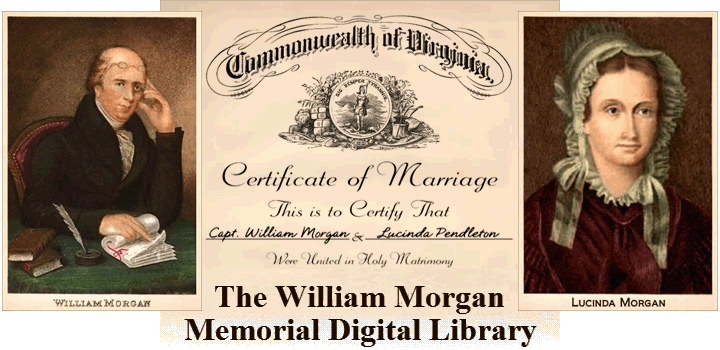
In the issue of May 25, same year, appears an affidavit from Rev. Thomas Colby, to the effect that he was the minister who married William Morgan to Lucinda Pendleton,
October 7, 1819, in Washington county, Virginia. This was in answer to a rumor that had been widely disseminated and largely credited, that this lady was only the mistress
of Morgan and not the wife.
David C. Miller having been charged with unlawful intercourse with widow Lucinda Morgan, procures a certificate from the LeRoy Anti-Masonic Committee. They had investigated
the current rumor. Their witness, John Davids, a savory name around Batavia, a former partner in the world-renowned publishing firm of Morgan, Miller, Davids & Dyer, testifies that
Mrs. Morgan is living at Stafford, that she resides in a respectable family and is patronized by ladies of the first distinction and gentlemen of the most honorable character. In her
deportment, he says, she is modest, in her walk humble, in her life holy. *
__________
* This is one of the literary productions that sparkle occasionally in the "Advocate," and were commonly known as taggarts. The author, Moses Taggart, died February, 1883,
at the age of eighty-two. He gave a series of Reminiscences of William Morgan on the occasion of the dedication of the Morgan Monument, September 11, 1883, where I stood
within five or six paces of him. He was an inveterate Anti-Mason to the last, and I was deterred from calling at his office for certain facts of which I was in pursuit, by a timely
warning that I should be insulted if I did. As a friend of Thurlow Weed, Mr. Taggart kept him posted in the movements in and about Batavia, for the columns of his (Weed's) paper,
the "Telegraph," at Rochester, and the "Evening Journal," at Albany. Judge Taggart was
276
WILLIAM MORGAN.
In the transactions of the National Anti-Masonic Convention, Philadelphia, 1830, I find an appeal for aid to Mrs. Morgan. She is represented therein, as a lady of a feeble
constitution.
In a poem styled Freemasonry, by a citizen of Lewiston, N. Y., 1830, is this allusion to Mrs. Morgan, and her lamented husband:--
"But he is gone, the one thou didst adore,
And weeps his loved Lucinda's fate no more;
From Lodge to Lodge their victim they convey
And many a Mason aids them on the way;
To Brandt they bear liim, but the savage chief,
Less than his Brethren is to mercy deaf.
Though by his hand had many a warrior bled,
Yet he declines a Brother's blood to shed."
In another chapter, I have hinted at Mrs. Morgan's second marriage, hurried forward at the advice of her Anti-Masonic friends to confirm public opinion in the idea of
her widowhood. No one, however, could blame the lady placed in the condition she was, the political sect upon whom she depended fast melting away.
From the "American Masonic Record" (Albany, December 11th, 1830), extracted from the "Courier and Enquirer," I copy an amusing notice of the marriage, with the
editorial comments. One can imagine the fun produced by its perusal through western New York. The article illustrates
__________
a pleasant composer, as witness the various communications signed by Lucinda Morgan, which I have reproduced in this volume, and all written by him. They went
commonly by the name of taggarts, as did many communications in Weed's paper. In the witty fourth column series of the New York "Times," describing the
National Christian Association, the writer describes the Association as mainly composed of Blanchards with a sprinkling of Taggarts! I must not forget to say that
Mr. Taggart was coroner's clerk at one of the inquests (the second one I think), held over the body of Timothy Monro. He was an honest man, and always in the
face of Miller, declared "that this was not the body of Morgan." When the Anti Masons began about 1878, to collect money for the monument above alluded to,
it was the purpose of the Illinois leaders in the movement to erect it over the grave of Timothy Monro, claiming in spite of all contradiction, that there lay William
Morgan! But Taggart forbade it, declaring that every old citizen of Genesee would stand up and deny it.
THE TIMOTHY MONRO AFFAIR.
277
the character of the attack and defense adopted by the parties in the Anti-Masonic strife: --
"The Question is Settled! Anti-Masonry is no more! Since the election it has received a vital blow; it is dead! Mrs. Lucinda Morgan, the afflicted widow of Captain William Morgan,
is married! This celebrated woman who, like Niobe, was all tears and affliction, whose hand was ever held forth to receive contributions from the sympathetic Anti-Masons, who vowed
eternal widowhood, pains and penance, is married! Is married, and, tell it not in Gath, married to a Mason! Behold: --
'Married. -- In Batavia, on Tuesday last (November 23d, 1830), by the Hon. Simeon Cummings, Mr. Geo. W. Harris to Mrs. Lucinda Morgan, widow of the late Captain William Morgan.'
The whole Anti-Masonic party is not alone the sufferer from this treacherous defection of one of their prominent lions or lionesses of the West, but we have some reason to apprehend
that a sighing swain has been cruelly treated in this business! Our friend Frank Granger, who is in single wrechedness, had an eye, it is whispered, upon the widow Morgan, and it was
recommended by Thurlow Weed and his cabinet, as an admirable stroke of policy to perpetuate the existence of Anti-Masonry, by perpetrating matrimony with the afflicted widow. But it
is also circulated at the Canandaigua tea-tables, that Mrs. Captain Bill Morgan, finding that Frank was not governor for more than three days, fairly gave him the bag to hold, or in other
words, jilted him. We have heard of many political somersaults in our time, but this is the cleanest we ever read of; a whole party of more than 100,000 voters, utterly prostrated, and left
struggling on their backs by the defection, secession, abduction and abandonment of a single woman!
We learn that couriers passed between Albany and Canandaigua on the occasion, and that Thurlow Weed will raise an important legal question before the Court of Errors, whether this
marriage of Mrs. Morgan is legal, it not having been seven years since the absence of her husband, and no positive proof of his death having been adduced. Weed says, "had she
postponed her marriage until after the presidential election, she might have had
278
WILLIAM MORGAN.
thirty-six husbands for all that he cared, but to be abandoned at this juncture is truly afflicting.
At the next session of the legislature, the afflicted Anti-Masons will be in a dreadful quandary. What is to be done? Mr. Maynard, no doubt, will make a long report on the awful event. Mr. Tracy
will spread out his hands and invoke all the spirits of eloquence to bring down vengeance on those who have intrigued Mrs. Morgan into matrimony. We thought a few days ago that something
was in the wind. Capt. Miller, the famous captain of Batavia, advertised his press and types for sale. The marriage has forced him to retire disconsolate from the field, -- no more excursions to
Seneca Lake, no more trips to Canandaigua waters, no more meditations in the neighborhood of the Cayuga marshes. There is no doubt that this most unfortunate defection of Mrs. Morgan
has been produced by the intrigues of the rascally Clay Masons in Oneida, Montgomery, Rensselaer, Albany and Columbia counties. The project was no doubt furthered by the Grand Chapter
of the State, and the most unholy means used against the integrity of the Anti-Masonic party to influence the too susceptible heart, to fascinate the pretty eyes, and carry by a
coup-de-main the lovely, the charming Mrs. Morgan. We understand that such is the consternation produced in the mind of Col. Stone and the Anti-Masons, by the fair one's defection,
that he intends to proceed, -- all his expenses to be paid by any party -- to the interior of the State to ferret out the intrigues of the Masons in this matter, and expose their awful machinations
to an indignant world. Let there be light!"
The next event in this lady's life occurred twenty-six years later, and long after the Anti-Masonic party passed out of existence. They moved westward, and either from some impropriety of hers
or his, matrimonial felicity was absent from their dwelling. A crim. con. is darkly insinuated in the following court records of Pottawatomie county, Iowa (the lady being then fifty-three
years of age). My extract is from the "Bugle," of Council Bluffs, Iowa, March 12, 1856:
THE TIMOTHY MONRO AFFAIR.
279
"STATE OF IOWA,
POTTAWATTOMIE C OUNTY. } ss.
TO MRS. LUCINDA HARRIS:
Madam, -- You are hereby notified that there will be on file, in the clerk's office of the District Court of Pottawattomie county, Iowa, on or before the 21st day of February, A.D.
1856, the petition of George W. Harris, claiming of you a divorce from the bonds of matrimony now existing between you and the said Geo. W. Harris, and charging you therein with
willfully deserting him, and without reasonable cause absenting yourself for more than the space of three years, and unless you appear and answer thereto, on or before the morning
of the second day of the next April Term of the District Court, in for said State and county, to be begun and holden at the Court House in the city of Council Bluffs, on Monday, the 7th
day of April, 1856, the matter and thing therein contained will be taken as confessed, and a default taken, and a decree rendered in accordance with the prayer of the said petition,
and a judgment rendered against you for costs of suit thereon. Notice returned not found.
A. C. FORD,
Solicitor for Complainant."
I have never learned what became of the two children, one born in 1824, the other in 1826. Mrs. Harris afterward joined the (Catholic) Sisters of Charity, and at the breaking out of
the civil war, was acting in that capacity in the hospitals at Memphis, Tennessee; there I lose sight of her. If living, she would now (1883) be about eighty years of age. Her union,
at the age of sixteen, was a runaway match, for which her father never forgave her, nor, during all her New York troubles, did she receive any comfort or sympathy from that quarter.
Let her drop quietly out of history. Her forlorn and heart-breaking visit to Canandaigua, September, 1826, is the one romance of her life.
|